
**This is independent, non-commercial research undertaken in the public interest. It was written to be shared freely and often, in the true spirit of knowledge sharing.**
I have a question for Ontario.
And I think we need to ask it before we build thousands of new jail beds.
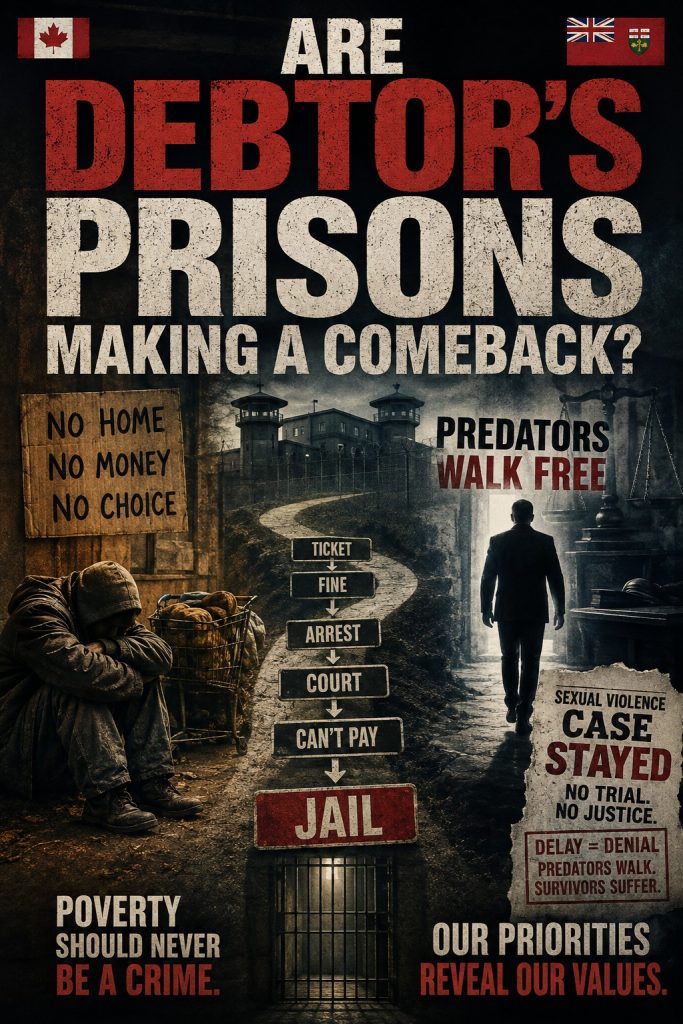
Are debtors’ prisons making a comeback?
Not literally.
Not yet.
But history has taught us to pay attention when poverty starts being treated like a crime.
There was a time when we put people in jail because they owed money.
In what is now Ontario, imprisonment for ordinary debt was abolished in 1843.
Britain followed in 1869.
The last American state to abolish ordinary imprisonment for debt was Rhode Island in 1870.
Forms of debtors’ prison still exist today.
In the United Arab Emirates, debtors can be imprisoned for failing to pay a debt (Government of the United Arab Emirates, 2022).
And, in Tunisia, people have also been imprisoned because they could not pay their debt (Human Rights Watch, 2024).
Think about that.
You have no money.
You can not pay your debt.
So we lock you up.
Eventually, Canada figured out something that should have been obvious from the beginning.
You cannot punish someone out of poverty.
Today, nobody is calling Ontario Premier Doug Ford’s proposed correctional facilities “debtors’ prisons.”
Neither am I.
I am asking a question.
What are we building all these jail cells for, and who is eventually going to fill them?
In May 2026, the Ford government announced a $3 billion expansion of Ontario’s correctional system, including more than 2,500 permanent jail beds over the next decade (Government of Ontario, 2026).
The government says the expansion is about tougher bail and sentencing laws and keeping violent and repeat offenders behind bars.
Fair enough.
But before we start filling thousands of new jail beds, I want to talk about something else happening in Ontario’s justice system.
People accused of sexual violence are walking out of court without a trial because we cannot get their cases before a judge fast enough.
In Ontario, 145 sexual assault cases were stayed because of unreasonable delay between 2016 and 2023.
Fifty-nine in 2023 alone (Office of the Federal Ombudsperson for Victims of Crime, 2025).
Earlier this summer, a Toronto gym teacher accused of sexual violence against a 17-year-old student had his charges stayed after showing up for trial for three days.
There was no judge available to hear the case.
Three days.
No judge.
Case stayed.
No trial.
No verdict.
The allegations were never decided in court (R. v. Miano, 2026).
That should scare the hell out of us.
And it makes me ask another question.
What cases did our courts have time to hear?
How much court time is being spent on property offences?
Auto theft?
Unpaid fines?
Provincial offences?
And all the other cases competing for limited courtrooms, judges, Crown attorneys and court staff?
Because resources are finite.
Ontario’s own Ministry of the Attorney General has identified losing criminal cases because they take too long to get to trial, known as Jordan delays, as its top operational risk (Ministry of the Attorney General, 2026).
The same government says it is dealing with increased volume and complexity in auto theft cases.
Now Premier Doug Ford wants tougher bail.
Tougher sentencing.
More enforcement.
And more than 2,500 additional jail beds at a cost of $3 billion.
So I am going to ask the uncomfortable question.
Where exactly does child sexual violence sit on our list of priorities?
Canada, Britain and the United States have centuries of history behind legal systems built around protecting property.
Steal the car.
Break the window.
Don’t pay the fine.
There is a system waiting for you.
But sexually violate a child and we might not even manage to get your case in front of a judge before the clock runs out.
Something is terribly wrong with that picture.
I am not saying someone should be allowed to steal your car.
I am asking why we can mobilize enormous political attention, police resources, court resources and billions of dollars for prisons while sexual violence cases are dying on the courthouse calendar.
Don’t tell me we are tough on crime.
Show me which crimes we are tough on.
Because a stolen car can be replaced.
A broken window can be replaced.
Property can be replaced.
A childhood cannot.
And now put homelessness into this picture.
The Ford government has been talking a lot about “restoring safety” to Ontario’s parks and public spaces.
And who is sleeping in those parks?
People without homes.
Let’s be clear about something.
Ontario’s Safer Municipalities Act did not suddenly give authorities the power to remove encampments.
Encampments were being cleared long before this law existed.
Municipal bylaws can already prohibit people from camping or living in many public parks.
Trespass laws can also be used.
People can be ordered to leave.
Tents and belongings can be removed.
Police can be brought in to assist with enforcement.
I have watched it happen.
Nobody was searching tents for illegal drugs first.
Nobody needed to.
Toronto’s own encampment protocol says police may be present to keep the peace, support City staff or assist in the enforcement of City bylaws and trespass notices (City of Toronto, 2024).
Then Ontario added another layer.
The Safer Municipalities Act became law in 2025.
Under that law, police and other designated officers can order someone consuming an illegal substance in a public place to stop or leave.
And the definition of public place specifically includes certain tents and structures being used as dwellings.
Failing to comply can lead to arrest.
A conviction can bring a fine of up to $10,000, up to six months in jail, or both (Government of Ontario, 2025).
So we already had ways to clear encampments.
Now we have added another way to police the people living inside them.
And that makes me ask why.
Now stop there for a minute.
The new law is specifically about illegal drugs.
It does not include alcohol or legally possessed cannabis.
But I want to ask something anyway.
When was the last time the cops busted down your door because you were sitting in your living room enjoying a beer?
And when was the last time you saw someone getting ticketed for smoking a joint at Yonge and Bloor, or walking down any other Toronto street smoking weed?
I live here.
I walk through clouds of weed smoke every time I step out my door.
Nobody seems particularly concerned.
So what changes when the person smoking or using drugs is homeless?
One enormous thing.
They don’t have a door to close.
They don’t have a living room.
They don’t have a backyard.
They don’t have somewhere private to go.
Their living room is the park.
Their bedroom might be a tent.
Their front porch might be a park bench.
When you have no home, your entire life becomes public.
And when your entire life becomes public, almost everything you do becomes available for somebody to police.
That is the part I want Ontario to think about.
We can debate drug use.
We can debate public safety.
We can debate encampments.
We should debate all of it.
But we also need to ask what happens when the person being told to leave has nowhere else to go.
Move where?
Go home?
What home?
Then comes enforcement.
Then maybe a ticket.
Then maybe an arrest.
Then court.
Then fines.
Pay with what?
And every person we bring into that system requires resources.
Police.
Court staff.
Crown attorneys.
Legal aid.
Judges.
Courtrooms.
Correctional officers.
Jail beds.
These resources are not unlimited.
We already know that.
Sexual violence cases being stayed because of court delays prove that something in this system is badly overloaded.
So what happens when we bring even more people into it?
If somebody cannot pay a fine, does that case take resources?
If somebody steals a car, does that case take resources?
If somebody is arrested because of something connected to surviving homelessness, does that take resources?
Of course it does.
So I want to know what Ontario is prioritizing.
I want to know how much court time goes to property offences.
How much goes to unpaid fines and provincial offences?
How much goes to sexual violence?
Which cases get priority when there are more trials than judges?
Which cases get bumped?
Which cases run out of time?
Which accused walks?
Because while all of this is happening, Ontario is spending billions expanding its correctional system.
That is the part that has me asking questions.
I am not accusing Premier Doug Ford of secretly building prisons for homeless people.
I don’t know his intentions.
Neither do you.
That is exactly why I am asking.
Are we slowly creating a system where poverty itself is not technically illegal, but almost everything you have to do to survive poverty can bring you into contact with police, courts and eventually jail?
And if we put more poor and homeless people through an already overloaded justice system, what gives?
Which cases wait?
Which cases run out of time?
Which person accused of sexual violence walks because we could not get their case before a judge?
That is where child sexual violence comes crashing into this conversation for me.
Because child sexual violence is exactly what the words say.
It is violence.
All of it.
I am not interested in language that makes child sexual violence sound smaller, cleaner or easier to swallow.
It is violence.
And when our justice system cannot even get these cases before a judge on time, I want to know what the hell we are doing.
To be fair, the Ford government is also spending money on homelessness prevention, shelters, affordable housing and supportive housing.
That belongs in this conversation too.
But I also want us to be honest about what we call housing.
Ford’s government counts long term care beds toward Ontario’s housing supply targets.
In 2023, Ontario reported 109,011 “new homes” toward its housing target.
That number included 9,835 new and upgraded long term care beds (Government of Ontario, 2024).
Would you count a bed in a long term care facility as your home?
When I hear “affordable housing,” I am thinking about a place where a person can actually live.
A bathroom.
A bedroom.
A fully operating kitchen.
A door they can close.
Not simply a bed in a facility shared with other people.
And definitely not a jail cell.
A home is not a jail cell.
Addiction treatment is not a jail cell.
Mental health care is not a jail cell.
Poverty reduction is not a jail cell.
And sleeping indoors because you have been incarcerated is not a housing strategy.
So here is my challenge to the people of Ontario.
Especially researchers.
Professors.
Graduate students.
Lawyers.
Journalists.
Politicians.
Frontline workers.
Survivors of sexual violence.
And people who have actually lived on the street.
Start following the numbers.
Who is being arrested?
Who is being fined?
Who cannot pay those fines?
Who is being charged with offences connected to surviving in public spaces?
What kinds of cases are consuming Ontario’s court time?
How much of that time is being spent protecting property?
How much is being spent addressing sexual violence?
How many sexual violence cases are being stayed because of delay?
How many involve children?
And as those 2,500 new jail beds come online, who fills them?
Maybe the numbers will prove my concern completely wrong.
Good.
Show me.
That is what research is for.
But history tells me we should ask these questions before the cells are full, not after.
When a government is spending billions building places to lock people up while people are sleeping outside because they cannot afford a place to live, and our courts are simultaneously failing to get sexual violence cases to trial on time, somebody should be asking questions.
So I am.
Are debtors’ prisons making a comeback?
Or have we simply found a 21st century way to punish poverty without calling it that?
And while we are doing it, who are we allowing to walk away because we were too busy to give them a trial?
A stolen car can be replaced.
A broken window can be replaced.
Money can be replaced.
A childhood cannot.
If Ontario is determined to build thousands of new jail beds, I would rather see those beds used for people convicted of child sexual violence than filled because we decided poverty needed tougher policing.
This is the original war.
The war against children.
Control the children and you control the parents.
Control the parents and you control the community.
Control the communities and you control the country.
Control the countries and you control the world.
History is watching.
So I will ask Ontario one more time.
Are debtors’ prisons making a comeback?
And if they are, maybe we need to ask ourselves who we are so determined to put behind bars, and who we keep allowing to walk free.
This is your moment to act.
History is watching you too.
 Copyright © August 22, 2026 Ghrian Shine
I receive no financial compensation for this work, nor am I conducting it as part of an academic program. I do this work because I am dedicated to ending child sexual violence through education, justice and a whole lot of love.
Please share this work freely. Please share it often, in the true spirit of knowledge sharing.
Annotated References
British North American Legislative Database. (1843). An Act to abolish imprisonment in execution for debt, and for other purposes therein mentioned. 9th December, 1843. University of New Brunswick.
This historical statute documents nineteenth century legislative efforts to abolish imprisonment for debt in British North America. It provides historical context for examining contemporary policies that may result in punitive legal consequences for individuals because of poverty or an inability to meet financial obligations.
City of Toronto. (2024). City of Toronto interdivisional protocol for encampments in Toronto. Toronto Shelter and Support Services.
This municipal protocol outlines Toronto’s coordinated approach to encampments, including outreach, shelter and housing services, health and safety considerations, and enforcement. It provides a policy framework for examining how municipal governments respond to homelessness and how enforcement measures intersect with poverty, housing insecurity, and the use of public space. The protocol also recognizes the continuing authority of officials, including police, to enforce applicable laws.
Government of Ontario. (2024). 2024 Ontario budget: Building a better Ontario. Ministry of Finance.
This provincial budget outlines Ontario’s fiscal priorities and planned government expenditures. It provides financial and policy context for comparing government investments in areas such as housing and homelessness with spending on policing, courts, correctional facilities, and other components of the justice system.
Government of Ontario. (2025). Safer Municipalities Act, 2025, S.O. 2025, c. 5.
This legislation enacted the Restricting Public Consumption of Illegal Substances Act, 2025 and amended the Trespass to Property Act. It is relevant to the discussion of homelessness and criminalization because its definition of a public place can include a tent being used as an unauthorized dwelling in a public space. The legislation provides an important contemporary example of the intersection between public space regulation, policing, substance use, homelessness, and provincial law.
Government of Ontario. (2026, May 14). Ontario expanding adult correctional capacity to keep dangerous offenders behind bars. Ontario Newsroom.
This provincial government announcement describes Ontario’s expansion of adult correctional capacity and investment in incarceration infrastructure. It provides evidence for examining provincial spending priorities and allows comparison between investments in correctional capacity and resources directed toward homelessness, affordable housing, poverty reduction, and the functioning of Ontario’s court system.
Government of the United Arab Emirates. (2022). Federal Decree-Law No. 42 of 2022 promulgating the Civil Procedure Code. Ministry of Justice. Article 319, “The Debtor’s Detention.” UAE Ministry of Justice legislation
Article 319 allows an execution judge to order the imprisonment of a debtor in specified circumstances involving failure to satisfy a debt. The law permits repeated periods of detention, with total imprisonment generally limited to 36 months.
Human Rights Watch. (2024, June 10). “No way out”: Debt imprisonment in Tunisia. Human Rights Watch report
This report documents the imprisonment of people in Tunisia for unpaid cheques used as a form of credit. Human Rights Watch describes the practice as a disguised form of imprisonment for debt and documents people imprisoned because they were unable, rather than simply unwilling, to pay what they owed.
Ministry of the Attorney General. (2026). Published plans and annual reports 2025–2026: Ministry of the Attorney General. Government of Ontario.
This government report outlines the Ministry of the Attorney General’s priorities, expenditures, programs, and performance measures. It provides institutional and fiscal context for understanding pressures facing Ontario’s justice system and for examining how government resources are allocated to courts and other justice services.
Office of the Federal Ombudsperson for Victims of Crime. (2025). Rethinking justice for survivors of sexual violence: A systemic investigation. Government of Canada.
This systemic investigation examines the experiences of survivors of sexual violence within Canada’s criminal justice system and identifies significant barriers to accessing justice. Based on extensive consultation with survivors and stakeholders, the report provides 43 recommendations for reform. Of particular relevance is its examination of R. v. Jordan and its recommendation to minimize the harm caused by court delays. The report provides important national evidence for considering the consequences of an overburdened justice system for survivors of sexual violence.
R. v. Miano, 2026 ONSC 4192 (Ont. S.C.J.).
This Ontario Superior Court of Justice decision provides a direct contemporary example of the consequences of court delay. The accused faced several charges of sexual assault and sexual exploitation involving a complainant who was 17 at the time of the alleged offences. The originally scheduled trial could not proceed because no judge was available. The court ultimately calculated a net delay of 950 days, exceeding the 30 month presumptive ceiling established by R. v. Jordan, and stayed the charges under section 24(1) of the Canadian Charter of Rights and Freedoms. The case is particularly relevant to examining the consequences of limited court capacity and systemic delay in serious sexual violence prosecutions.
Rhode Island. (1870). An Act abolishing arrest and imprisonment for debt.
This nineteenth century statute provides a comparative American example of legislation abolishing arrest and imprisonment for debt. It demonstrates that concerns about incarcerating individuals because of unpaid financial obligations have a long legal history extending beyond Canada and provides historical context for examining modern practices that disproportionately affect people living in poverty.
United Kingdom. (1869). Debtors Act 1869, 32 & 33 Vict. c. 62.
The Debtors Act 1869 significantly restricted imprisonment for debt in England and Wales and represents an important development in the historical movement away from debtors’ prisons. It provides broader legal and historical context for considering contemporary practices that may impose escalating legal consequences on individuals who lack the financial resources to pay fines, fees, or other monetary penalties.
Copyright © August 22, 2026 Ghrian Shine
I receive no financial compensation for this work, nor am I conducting it as part of an academic program. I do this work because I am dedicated to ending child sexual violence through education, justice and a whole lot of love.
Please share this work freely. Please share it often, in the true spirit of knowledge sharing.