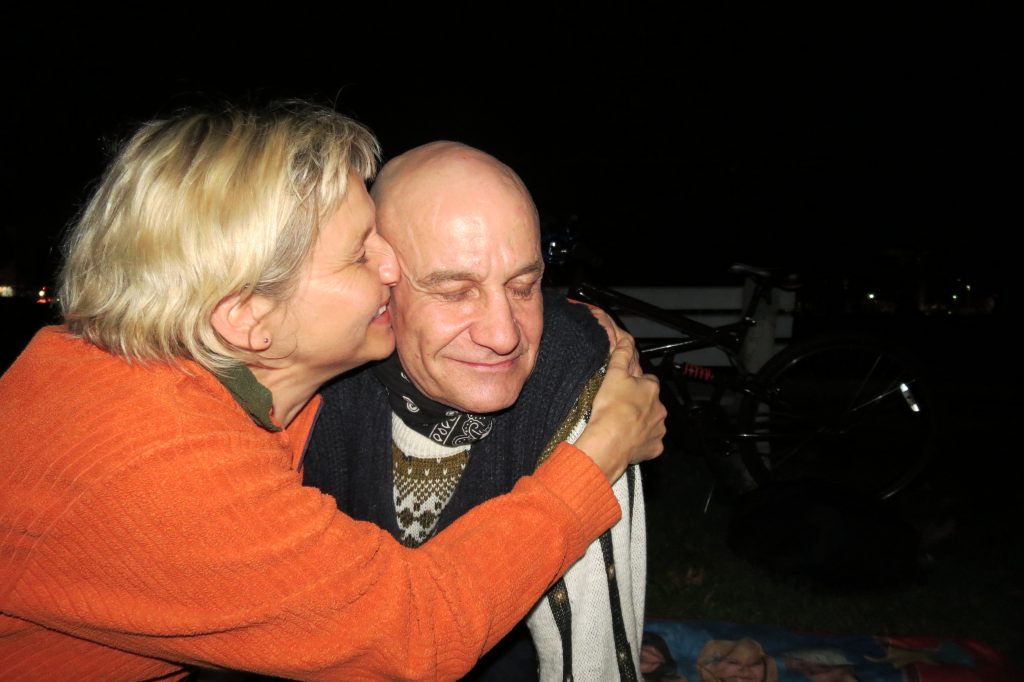
My brother and me in a park in Hamilton, October 27, 2017.
On December 23, 2021, I organised my brother’s funeral.
Five years later, on that very same day, I’ll be walking into the freezing waters of Lake Ontario.
Holy shit.
Of all the dates on the calendar.
But I’m getting ahead of myself.
Let me tell you about my saggy bottom and a little thing called science.
Last May, I challenged myself to 40 days of cold-water plunging. Forty days of willingly walking into freezing water when most sensible humans were reaching for another blanket and a hot cup of tea.
I did it.
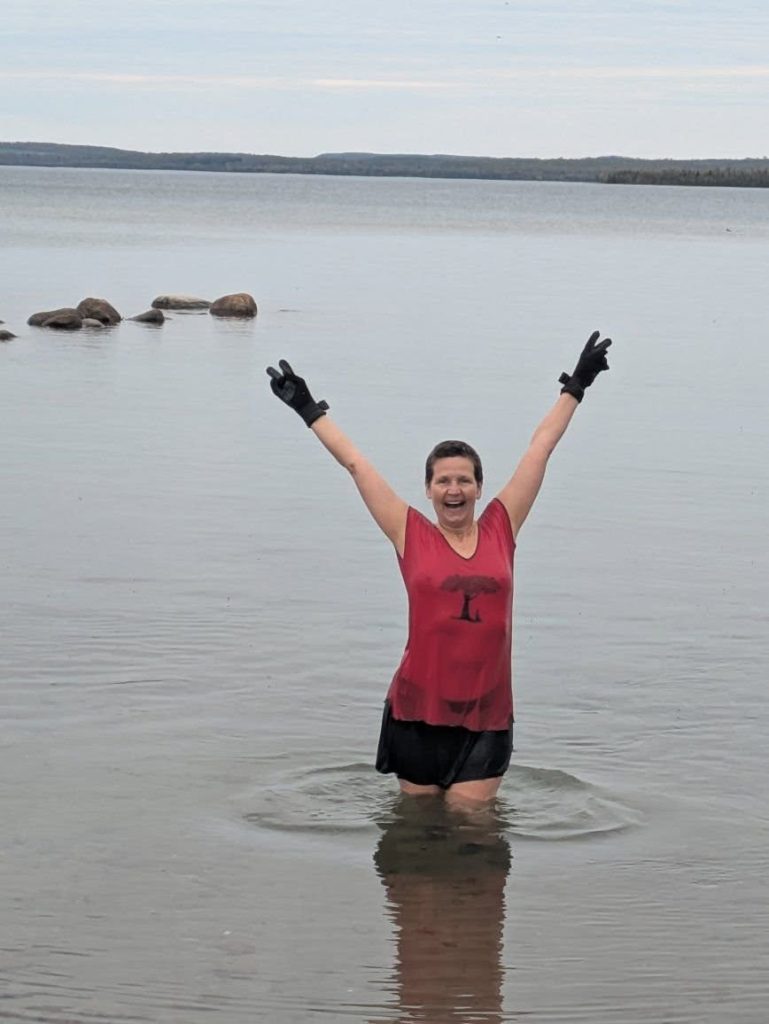
Day 1 of my cold-water plunge challenge while attending the Beyond Addiction program in Owen Sound, Georgian Bay, May 15, 2026.
And apparently, 40 days wasn’t enough.
Because after that challenge, I decided to take my love affair with water on the road.
Five Great Lakes. Eighteen days. One hell of an adventure.
I swam in Lake Ontario, the waters I was born beside. Lake Erie brought out my playful side as I became the Sea Witch. Lake Huron reminded me of the ever-changing landscapes of this stunning country I am privileged to call home. On the shores of Lake Michigan, I built a sandcastle village for my late nephew, and at Gichi-Gami, Lake Superior, I stood in awe of a magnificent beach with more than three kilometres of sand stretching before me.
One day for every year of my childhood.
I carried rocks in my pockets, memories in my heart and the spirits of my late brothers and nephew along for the ride.
It was never just about swimming.
It was about grief, healing, honouring Indigenous names and histories, and finding joy in a body that has endured more than its fair share of violence.
I wrote about that journey in Words Have Power. Water Heals.
And now?
I’ve decided to up the ante.
Sixty-six days.
Yep. Sixty-six days of getting my saggy bottom into cold water. And as of today, October 27, that bottom is officially 62 years old!
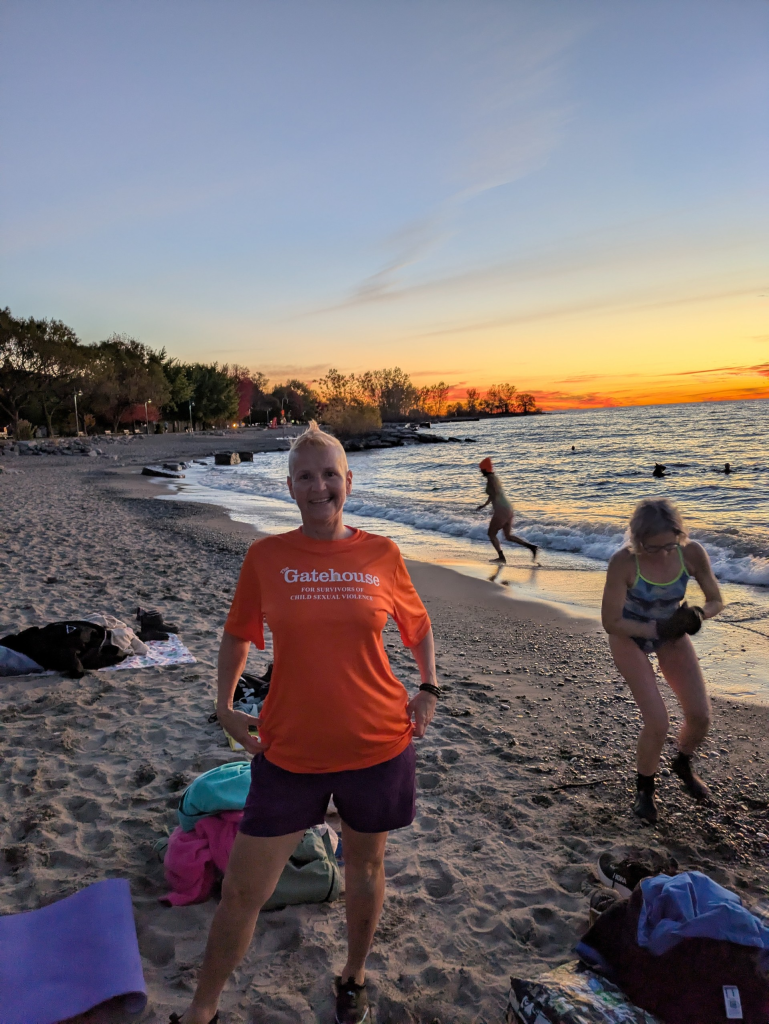
I started on October 18, 2026.
Day 66 will be December 22.
And Day 67?
December 23.
Hold that thought. We’ll come back to it.
Because Science, My Friends!
Why 66 days?
In a 2010 peer-reviewed study published in the European Journal of Social Psychology, researcher Phillippa Lally and her team examined how long it takes for a new behaviour to become automatic.
Their findings? A median of 66 days.
But here’s the interesting part. Depending on the person and the behaviour, the researchers estimated that forming a habit could take anywhere from 18 to 254 days.
Heck, it took me less than 10 seconds to get hooked after my first hit of crack cocaine all those years ago. I guess that makes me a super addict. Or was I just a super sucker?
But here’s the thing. My addictions saved my life. You try surviving 15 years of child sexual violence starting at three years old and see how you fare without finding some way to numb the fucking pain.
But that’s another article. Or you could just read my memoir, Breathing the Night Out, because sometimes an article just doesn’t cut it.
So, 66 days isn’t some magical number. And on Day 67, nobody is going to hand me a certificate declaring that I have officially become a cold-water warrior.
Although, frankly, I think someone should.
Preferably with a crown.
And chocolate.
But there is something powerful about showing up for yourself every single day.
Especially when showing up means stepping into discomfort.
The Water Heals Me
I’ve been cold-water plunging for almost two years.
I’ve plunged in Lake Ontario weekly through the changing seasons, carrying memories of people I love tucked inside my heart.
The wind moves me.
The water heals me.
The land holds me.
The sun gives me strength.
For me, cold-water plunging is about far more than building a healthy habit.
It’s about coming home to my body.
And believe me, my body and I have had one hell of a relationship.
Child sexual violence was part of my childhood. Its consequences followed me well into adulthood.
My body remembers things I wish it didn’t. There are memories buried deep within me that don’t always come with words.
But the water?
The water doesn’t ask me to explain.
It doesn’t ask me to justify my feelings, defend my experiences or prove that what happened really happened.
It simply holds me.
When I step into that cold water, I make a choice.
I choose what happens to my body.
For someone whose bodily autonomy was stolen during childhood, that choice means a great deal.
Cold-water plunging has science behind it, too. Dr. Andrew Huberman, a neuroscientist at Stanford University, suggests roughly 11 minutes of deliberately uncomfortable cold exposure each week, spread across short sessions. I never stay in longer than two minutes per session. Research is exploring its effects on stress, sleep, metabolism and well-being, although there’s still plenty we don’t know.
But for me, the science is only part of it.
I enter the discomfort.
I trust the water to touch the parts of my body that were attacked when I was a child.
The water heals me.
I stay calm.
I let my body do the work.
Because my body remembers.
It remembers everything.
I’m not suggesting that jumping into a freezing lake magically heals trauma. It doesn’t. Healing is far more complicated than that.
I know because I’ve lived it. I am living it.
I found my way to The Gatehouse, an organization dedicated to supporting people who have survived child sexual violence.
There, I found something I desperately needed: people who believed in me.
Through the love and support of volunteers guided by trained professionals, The Gatehouse helped me find my voice, reclaim my strength and return to the fight.
They guided me out of a dark place and back into the light.
The Gatehouse saved my life.
I arrived as a survivor.
It takes a lot to survive. It takes courage and determination to become a warrior.
Today, I am a warrior. A Beloved Warrior, fighting to end child sexual violence with education, justice and a whole lot of love.
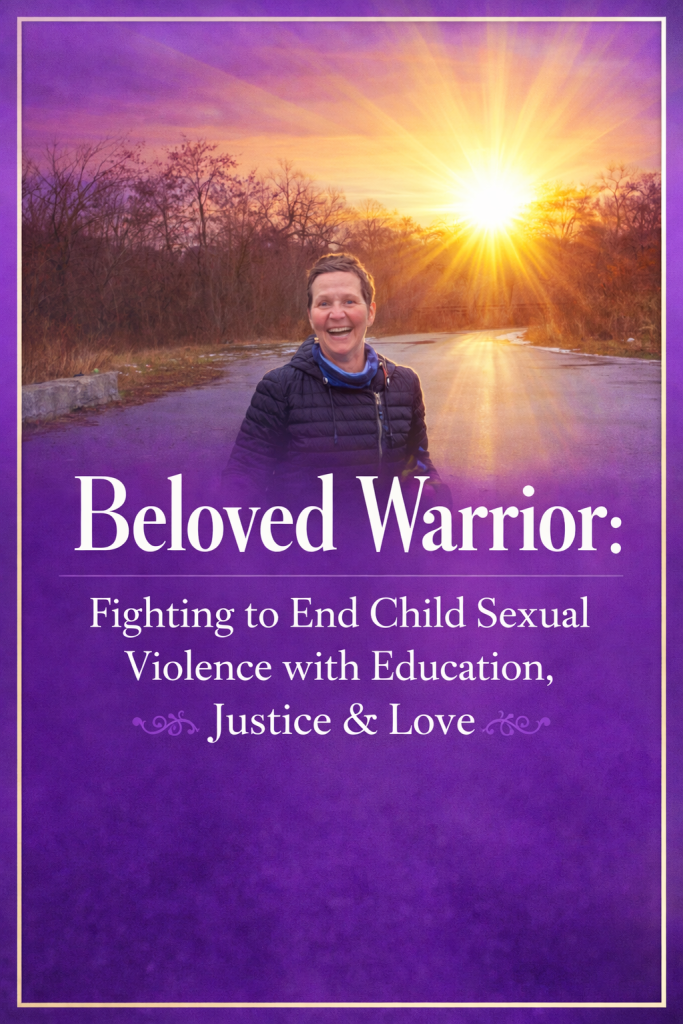
And cold-water plunging is one of the ways I continue caring for myself.
Writing, yoga, hiking, dancing, collaging, cooking healthy food, spending time in nature and, weirdly enough, cleaning houses. Who knew?
They’re my medicine.
They get me out of my head and back into my body.
Back into the world.
Back into life.
December 23: The Date I Didn’t See Coming
When I decided to begin my 66-day challenge on October 18, I wasn’t thinking about where Day 67 would land on the calendar.
Then I did the math.
December 23, 2026.
Five years earlier, on December 18, 2021, my second brother died.
On December 23, 2021, I organised his funeral.
Funerals matter. They give us a chance to say goodbye, embrace the people we love and honour those we’ve lost. COVID robbed so many of us of those rituals. I buried my nephew and one of my brothers during the pandemic, when gathering to grieve was anything but simple.
Perhaps that’s why funerals mean so much to me now. We need those moments to come together, to hold one another, to cry, to laugh and to remember. Grief is hard enough without having to carry it alone.
And now, five years later, December 23 will mark Day 67 of my cold-water challenge.
Holy shit.
Of all the dates on the calendar.
I’ve written before about my belief that the souls of our dead live in the water for eternity.
I’m not religious.
I’m spiritual.
When I’m in the woods, I can sense my late brothers and my nephew.
When I’m in the water, I can feel them surrounding me with love.
They may have died from drugs, but child sexual violence killed them years before they stopped walking this earth.
That’s how I understand what happened to my family.
The violence didn’t end when childhood ended.
It followed us.
It shaped our lives, our relationships, our struggles and our losses.
I don’t know what to make of that.
Maybe it’s coincidence.
Maybe it’s one of those strange moments when life reminds us how closely grief and love live together.
I don’t need to explain it.
I just need to feel it.
Because on December 23, when I walk into that water, I know who I’ll be thinking about.
My brothers and my young nephew.
And all the people I love who are no longer walking this earth.
The water holds their memories.
And it holds me.
A Beloved Warrior Needs to Recharge
Being a Beloved Warrior is not simply something I say.
It is how I have chosen to live my life.
The Gatehouse helped me find my way back into the fight. Now I use my voice to challenge the silence that allows child sexual violence to continue.
I’ve written a memoir, Breathing the Night Out: A Story of Intergenerational Sexual Violence and Healing.
I’ve researched the staggering economic cost of child sexual violence in Canada in a piece titled $4.7 Trillion.
I’ve written to politicians, contacted journalists, shared my story and asked people in positions of power to pay attention.
I’ve facilitated writing workshops, sat on panels discussing the impacts of child sexual violence and donated a portion of my book proceeds to The Gatehouse.
I’m currently collaborating with a group of like-minded professionals to write a textbook dedicated to ending child sexual violence. Not one of us is being paid. We’re doing this because we believe in the work and the difference it can make.
We’re all doing our part, the best way we know how.
And there is so much more work to be done.
Sometimes they listen.
Sometimes they don’t.
Sometimes I feel like I’m screaming into the fucking wind.
But I keep going.
Because child sexual violence doesn’t end when childhood ends.
It follows people into adulthood. Into relationships, workplaces, hospitals, courtrooms and sometimes prison cells.
It follows families across generations.
I’ve watched what that violence has done to people I love.
I’ve buried people I love.
I’ve also sent people I love to prison.
And I refuse to accept that this is simply the way things are.
Silence is violence.
Until we name it, count it and confront it, the violence keeps winning.
But here’s something I’ve had to learn along the way.
Even a Beloved Warrior needs to rest.
I cannot spend every waking moment fighting systems, challenging silence and demanding accountability.
I need joy.
I need laughter.
I need community.
I need to dance like nobody is watching, even when somebody probably is.
And apparently, I need to jump into Lake Ontario 66 days in a row.
Go figure.
Finding My Tribe
One of the most beautiful things about cold-water plunging is the people I’ve met along the way.
Beautiful humans who willingly gather at the edge of a freezing lake, strip down to their bathing suits and encourage one another to walk into water that would send most people running in the opposite direction.
What a bunch of weirdos.
My kind of weirdos.
On October 18, World Menopause Day, I stood alongside hundreds of beautiful humans as we stepped into freezing Lake Ontario to raise awareness and funds. And it wasn’t just women taking the plunge. A few brave men joined us.
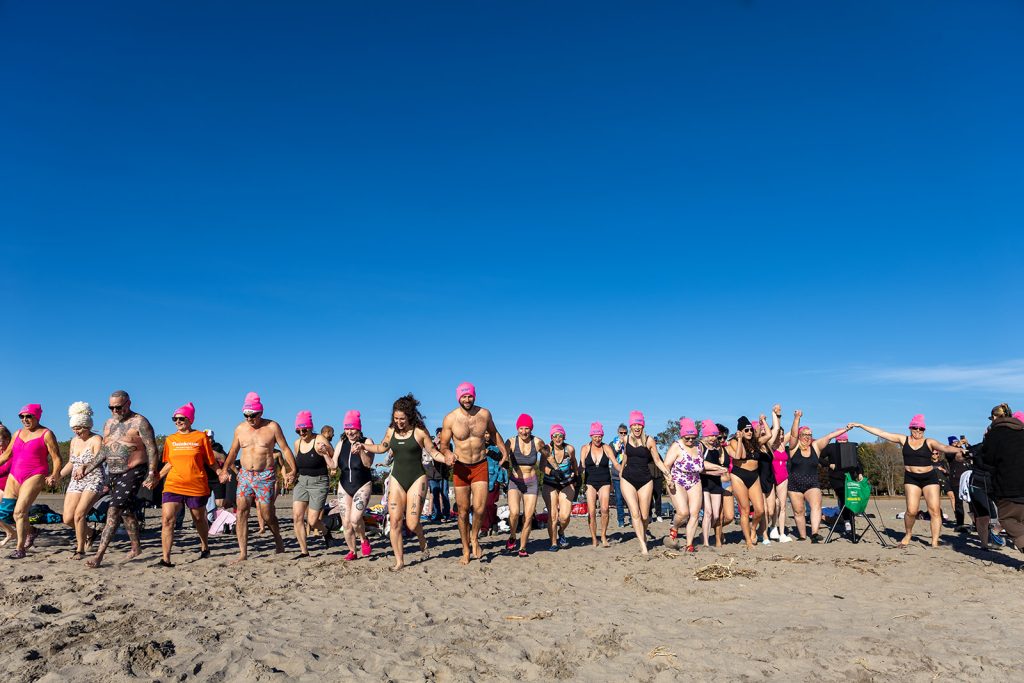
Those men deserve a special shout-out.
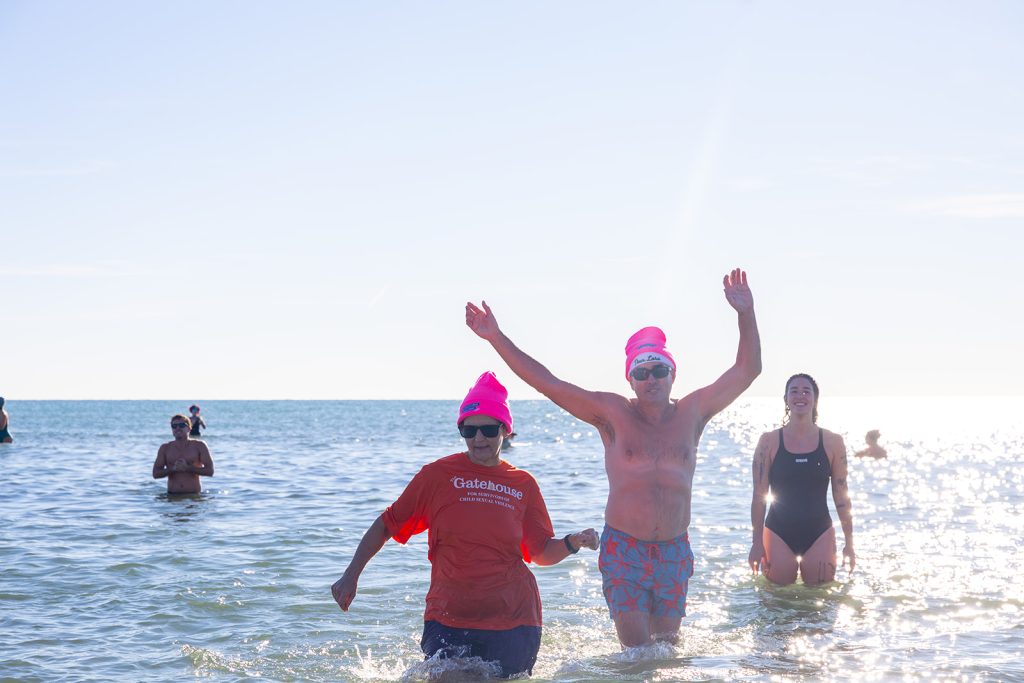
Some had already buried the women they loved after battles with cancer. Others were fighting alongside the women in their lives, hoping for one more day together. And there they were, stepping into freezing water to honour and celebrate them.
Now, that’s what I call showing up for one another.
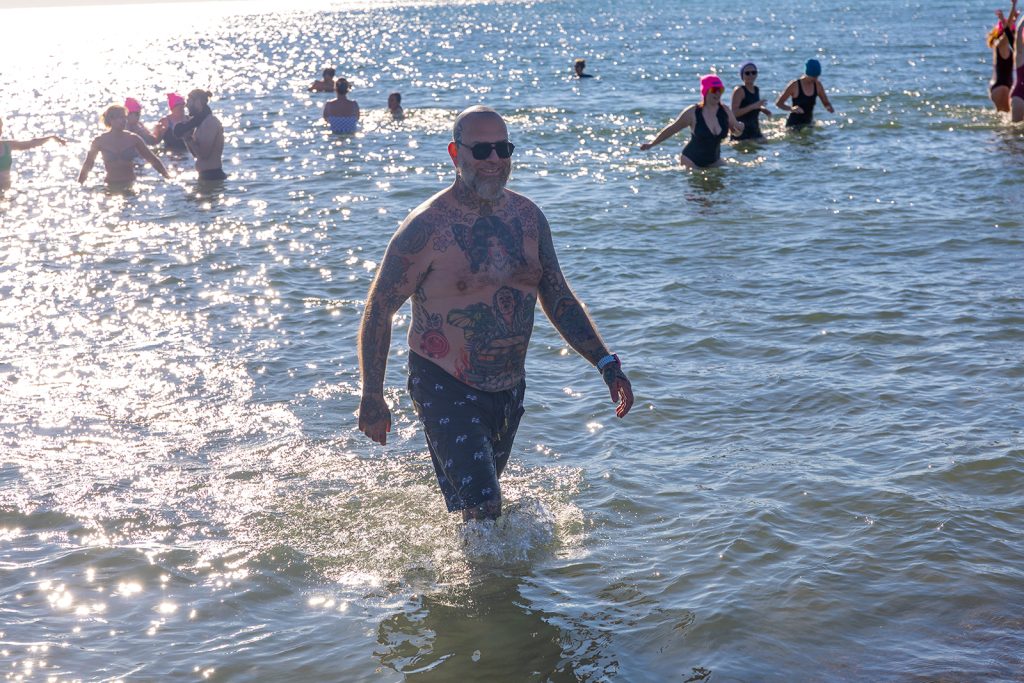
Male. Female. We’re all in this together.
We are one.
Every morning at dawn, I gather with a beautiful group of humans on the shores of Lake Ontario. We hug, we sing, we laugh. Someone brings hot coffee, someone brings cake, and everyone brings a little love. We hold hands, step into the freezing water and welcome another day together.
We are Water Warriors.
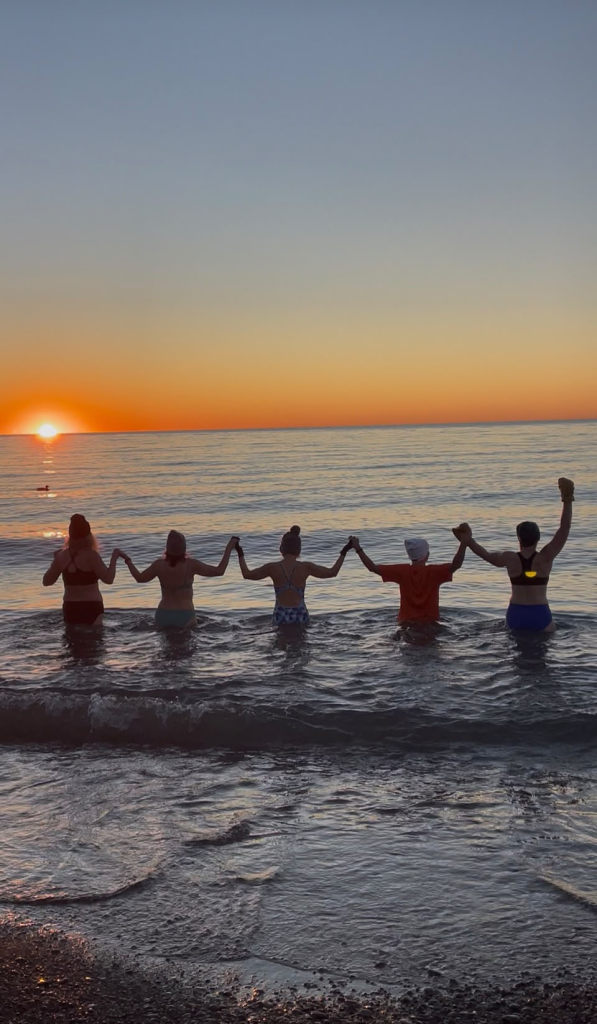
Loving life, embracing the cold and whatever comes next.
Together.
There’s something wonderful about being surrounded by people who understand that joy doesn’t always come wrapped in comfort.
Sometimes joy is standing waist-deep in freezing water, laughing your ass off with someone you met five minutes earlier.
Sometimes it’s watching the sunrise over Lake Ontario.
Sometimes it’s the simple pleasure of knowing that you showed up.
Again.
And again.
And again.
Science backs up something I’ve learned through cold-water plunging, expressive arts, dancing, yoga, hiking and sharing food: meaningful connections can be good for our mental health. But you know what? I didn’t need a research paper to tell me that. I just needed to find my tribe.
Community matters.
Connection matters.
Love matters.
And for someone who spent so many years simply trying to survive, finding joy in ordinary moments is extraordinary.
So, What’s the Point of 66 Days?
Am I trying to prove that I can withstand freezing temperatures?
Nope.
Am I hoping to develop a lifelong habit?
Absolutely.
But more than that, I’m reminding myself that I can make a commitment to my own well-being and honour it.
One day at a time.
Some days will be beautiful.
Some days the wind will be brutal.
Some mornings I’ll probably stand on the beach wondering what the hell I was thinking when I came up with this idea.
But I know why I’m doing it.
Because I want to live.
Not just survive.
Live.
Fully. Joyfully. Playfully.
I want to keep finding beauty in the pain, without pretending the pain itself is beautiful.
I want to keep learning.
Keep laughing.
Keep loving.
And keep fighting for a world where children are safe.
A world where children don’t have to spend their adult lives trying to heal from what happened to them when they were little.
A world where governments stop looking the other way, communities stop turning their backs, and families stop rejecting those who dare to speak the truth about child sexual violence. A world where we finally invest in prevention, healing and justice.
That is the world I’m fighting for.
Not with hatred.
Not with revenge.
But with education, justice and a whole lot of love.
Because that’s what being a Beloved Warrior means to me.
So, for 66 days, I’ll be showing up at the water’s edge.
Breathing.
Laughing.
Sometimes swearing.
Always grateful.
And when December 23 arrives?
I’ll be standing in the water, honouring my brothers and my young nephew, and reminding myself that mine is still a life to be lived.
Maybe I’ll have created a lifelong habit.
Maybe I’ll have made a few more beautiful friends.
Maybe I’ll have learned something new about myself.
Or maybe I’ll just be standing in Lake Ontario, freezing my ass off, wondering why anyone would ever want to stop.
And if there’s one thing I hope you’ll take away from my journey, it’s this: find your people, speak your truth and never underestimate what a whole lot of love can accomplish.
The wind moves me.
The water heals me.
The land holds me.
The sun gives me strength.
And love?
Love keeps me in the fight.
I am a Beloved Warrior, fighting to end child sexual violence with education, justice and a whole lot of love.
May the long time sun shine upon you.
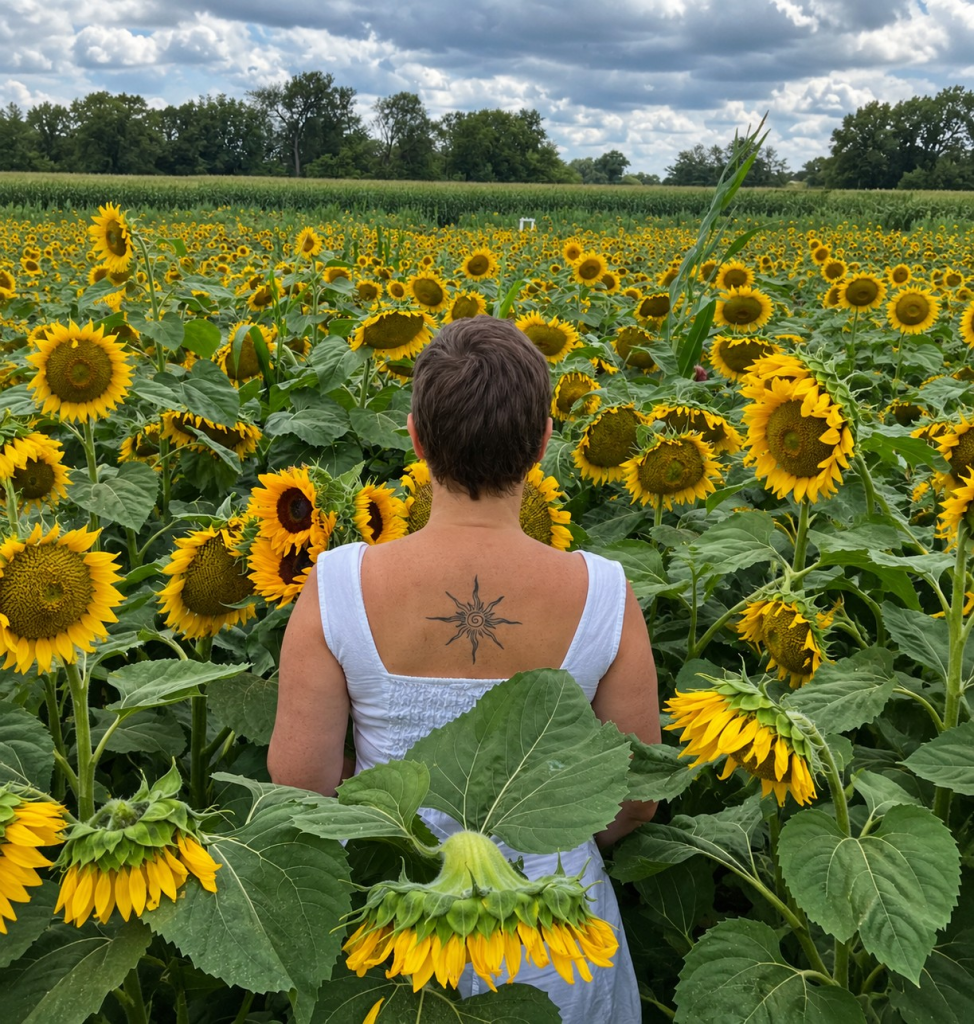
~ Ghrian Shine
Annotated Bibliography
Lally, P., van Jaarsveld, C. H. M., Potts, H. W. W., & Wardle, J. (2010). How are habits formed: Modelling habit formation in the real world. European Journal of Social Psychology, 40(6), 998–1009. https://doi.org/10.1002/ejsp.674
This peer-reviewed study followed participants as they repeated everyday behaviours and measured how automatic those behaviours became. The researchers found a median of 66 days to reach their modelled level of automaticity, with substantial variation between people and behaviours. The findings challenge the popular idea that every habit forms in just 21 days.
Singh, B., et al. (2024). Time to form a habit: A systematic review and meta-analysis of health behaviour habit formation and its determinants. Healthcare, 12(23), 2488. https://pmc.ncbi.nlm.nih.gov/articles/PMC11641623/
This systematic review examines research on how long health-related habits take to form. It reinforces that habit formation varies considerably and depends on the behaviour, the individual and the circumstances. It provides a broader research perspective on why 66 days is a useful inspiration rather than a universal deadline.
Haslam, C., Cruwys, T., Haslam, S. A., Dingle, G., & Chang, M. X.-L. (2016). Groups 4 Health: Evidence that a social-identity intervention that builds and strengthens social group membership improves mental health. Journal of Affective Disorders, 194, 188–195. https://doi.org/10.1016/j.jad.2016.01.010
This study explores the mental-health benefits of strengthening meaningful social group connections. It supports the broader importance of belonging and community for well-being. Although it does not specifically investigate cold-water plunging, expressive arts or other activities described in this article, its findings help explain why finding a supportive community can be so valuable.