
Malcolm Gladwell is a Canadian journalist, author, and public speaker. He’s been writing for The New Yorker since 1996, and he’s published eight books that changed how we talk about psychology, culture, and human behaviour.
Drawing from Chris Anderson and David Sally’s book The Numbers Game, Gladwell breaks something down that’s dead simple.
Basketball is a strong-link game. If you’ve got a superstar, they can drag the whole team over the finish line. Everything’s built around the strongest player. Everyone else just tries not to mess it up.
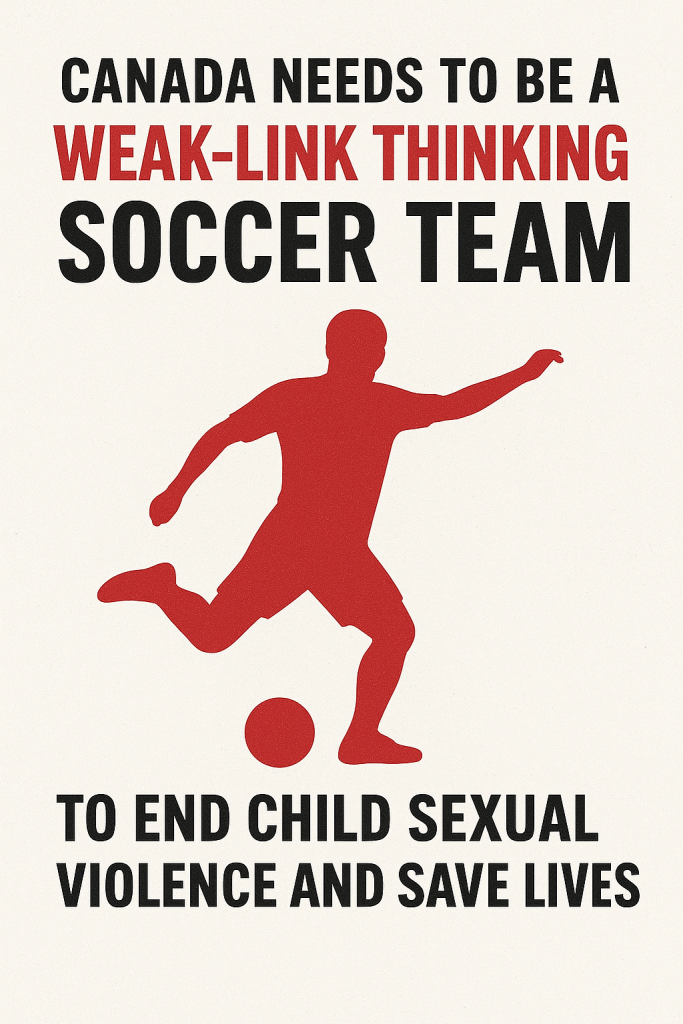
Soccer (American/Canadian term, every where else it’s called football) is the opposite. It’s a weak-link game. One struggling player can wreck 90 minutes for everyone. You win by lifting the whole team, not by relying on one hero.
Most Western systems—healthcare, education, the economy, and even the few charities the government deems “worthy”—are built like basketball teams. We pour resources into the stars, the big projects, the shiny “best-case” scenarios. And we tell ourselves that if the top performers thrive, everyone else will magically benefit.
Then COVID hit, the mask came off, and reality hit hard. Society isn’t a basketball team—it’s a soccer team. Ignore the weak links—the overlooked people, the underfunded systems, the communities on the edge—and the whole thing falls apart.
Now take that same idea and apply it to unresolved trauma.
Child sexual violence is a weak-link crisis.
Not because survivors are weak — but because the weight they’re forced to carry exposes exactly where our systems are weakest.
When we leave millions of people to deal with the aftermath alone, everyone pays for it:
- in hospitals
- in mental-health crises
- in addictions
- in lost futures
- in prisons
- in pain passed from one generation to the next
- in quiet suffering that never makes the news
A basketball mindset says:
“Fund the flashy stuff. Back the strongest. Cross your fingers and hope it trickles down.”
A soccer mindset says:
“If the person struggling the most isn’t supported, we all lose.”
Give this interview a listen: Malcolm Gladwell explaining the idea, using COVID as an example. While you listen, try a simple experiment — replace “obesity and COVID test” with ending child sexual violence through “mental health support and education,” and watch how the logic hits even harder.
Helping people heal — especially people living with the aftermath of child sexual violence — isn’t charity.
It’s strategy.
It’s nation-building.
It’s the only approach that actually works.
When we support our weak links, the whole country gets stronger: families, neighbourhoods, schools, workplaces. Everything rises.
If we want a country that truly thrives, we need to stop acting like a basketball team.
We need to start playing like soccer.
Lift up the people carrying the heaviest load, and everyone rises with them.
Be a soccer team.
Together we heal.
Together we fight to end child sexual violence with education, justice and love.