An excerpt from my memoir, Breathing the Night Out, Chapter 66 – Smiling Wide.
For more than a decade, I had some pretty extraordinary imaginary friends. Indigenous women who broke barriers, challenged systems, kicked down doors and, in many cases, made history while the rest of Canada wasn’t paying attention.
Sometimes I had the incredible privilege of meeting these trailblazers in person. Those were special moments. Most of the time, though, it was just me, their stories and a whole lot of admiration.
Through their stories, I found inspiration, motivation and a sense of connection. These extraordinary women helped me believe that perhaps I, too, could find a community where I belonged, where I could contribute something meaningful. And sometimes, just sometimes, I caught myself believing in me.
Of all the work I did throughout my post-secondary education, this was hands down my favourite. And believe me, I did a shitload of assignments!
I’m still waiting to hear what the University of British Columbia has done with the research I donated. My one stipulation was that it remain freely available to everyone. Perhaps they’ve turned it into a FREE course. I certainly hope so.
Some things should never be for sale. Education about the remarkable women who helped shape this country is one of them.
Anyway, enough from me today. Here’s what I wrote about this labour of love in my book….
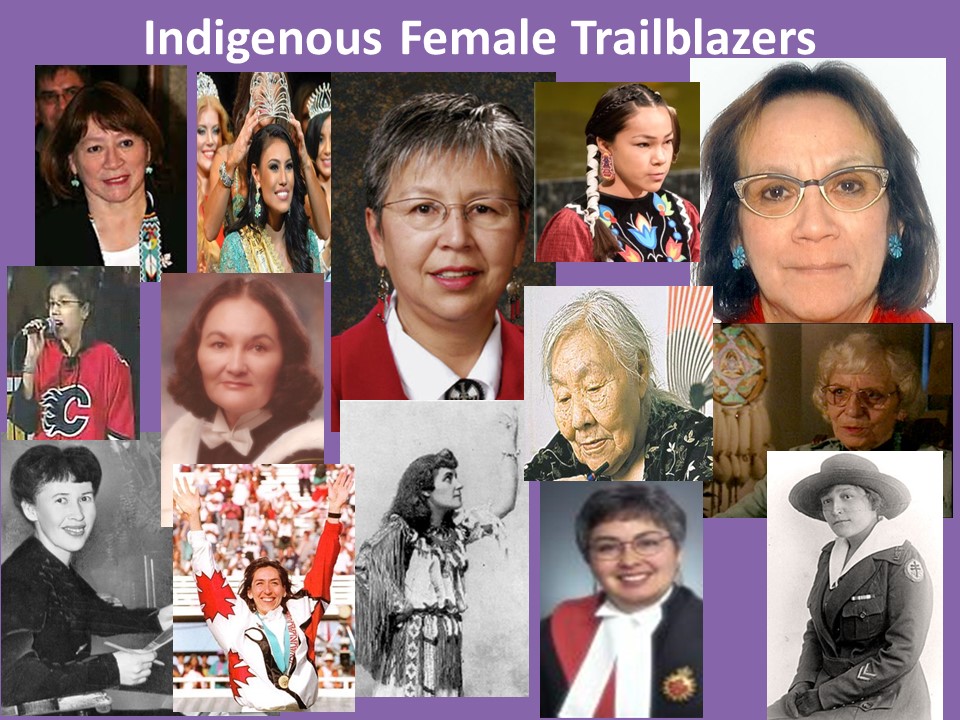
Seeking connection to a healthy community started for me in university. One of my courses was Indigenous Women’s Studies. The final assignment? A creative project honouring Indigenous women. I started it in 2012, so when the TRC came out in 2015, I thought, wow, I’m already doing a couple of these actions. This list counts.
To be honest, it was my Indigenous professor, Dr. Carol Leclair, who pointed that out to me years later—after I’d already handed in my assignment. Leclair is part of the Manitoba Métis Federation. Her PhD is called Métis Environmentalism: La Tayr pi tout li Moonde—the last part means, “The Earth is for everyone.”
Think about it: how many times did a professor reach back years later just to help you see your work mattered? For me, only once. That email wasn’t required. No one paid Dr. Leclair to do it. She did it because she’s trying to help Main Stream Canada connect the dots.
Back to me in the planning stages of the project. I thought I’d keep it simple: find an “Indigenous Female Firsts” list online (first neuroscientist, first dentist, first lawyer, and so on), pick 10 remarkable women, write their bios, and make a photo collage. Easy. A week’s work, tops. Except… the list didn’t exist.
That should’ve been the end of it. Most people would’ve picked another topic and moved on. But not me. My stubborn streak and my OCD locked in. Suddenly I was scouring the library until closing, digging through old newspaper archives, cold-calling professional associations, even phoning Parliament Hill. Every time I uncovered a new trailblazer, I’d get pulled into her story, her fight, her barriers, her relentless determination to build a better life and lift her community. I couldn’t walk away.
Their resilience didn’t just inspire me—it made me feel less alone. I’m not Indigenous, so I knew I’d always be an outsider to those communities and ceremonies. But this growing list became my own quiet circle of strength, a catalogue of what is possible.
What started as a class project caught national attention. It was featured in over a dozen publications, including The Toronto Star. That happened because, after much begging, Mom carved out five minutes from her busy retirement and wrote two teeny, weeny paragraphs; that woman can write powerful press releases in her sleep. But really, that five minutes came from over 36 years of being a journalist. My bloodline is full of geniuses from both sides; they just have to choose to do “Good Work.”
I petitioned the federal government to honour these women. They listened. They even drew from my research. On Canada’s 150th birthday, The Honourable Dr. Lillian Eva Dyck, a Senator and the first Indigenous female in Canada to earn a PhD in neuroscience, who snuck into university pretending to be Chinese, unexpectedly stood in the Liberal Senate and recognized my work. I didn’t even know it was happening until it was done. In Canada, it was illegal for Indigenous people to go past high school until the late ’60s.
The list became my greatest pride and joy through my years in higher education. I kept building it for 13 years—223 names in the end—until I donated it to the University of British Columbia (UBC). You will learn further on down how my life dramatically changed because of an accident and I needed to stop the research, we’re not there yet.
Here’s something I’ve never said out loud: in February 2025 I donated the list because I was planning to end my life. I couldn’t let the list die with me. To me it stood for the kind of equity, diversity, and inclusion we pretend to care about but so rarely deliver. My only request was that UBC remove my name. This wasn’t a “Mother Teresa” move; it was me fighting my deadliest addiction: the endless hunger for love and attention.
The truth? The work mattered more than the person who made it. I hope UBC keeps the list free and keeps working on it. Some things shouldn’t be for sale. And yeah, just like I was doing, UBC can point to it and pat themselves on the back, saying they’re answering some of the 94 TRC Calls to Action. It’ll buff up their Equity, Diversity and Inclusivity (EDI) report to the Ministry of Post-Secondary Education and Future Skills, the body they ultimately answer to.
After all these years I finally get why the list rubs some people the wrong way. The project I poured myself into reads like a white man’s list. You can argue its uses: Indigenous people can use that “first” status to get invited to the party: the places where laws get made, the World Health Organization (WHO), the Senate. Take Marion Ironquill Meadmore, the first Indigenous female lawyer in Canada, who worked tirelessly for Indigenous rights, with a particular focus on supporting urban Indigenous communities. Or Dr. Mary Jane McCallum, the first Indigenous woman dentist in Canada, who later became a senator and works with the WHO on dental health for all Canadians. So yes, a list like this can buy some credibility in a system that loves celebrating “firsts.”
From an Indigenous point of view, that list can feel small and even insulting. I can see both sides now. Maybe it should go straight to Indigenous organizations and let them decide. Maybe it’s time I stop turning it over in my head. I gave it away. It’s free now. My OCD has been brutal lately. Or maybe it’s just the old addiction to love and attention. Probably both.
Then I remember what Justice Murray Sinclair, Chair of the Truth and Reconciliation Commission of Canada, once said: “Education got us into this mess. Education will get us out of it.” And I continue. Often I don’t know what I am doing, which toes I am stepping on. But I don’t stop, because all Canadians need to know the truth. I believe in my heart that if people understand their history—the truth—they will connect the dots of how we treat vulnerable, underserved, targeted people. One day it could be them next. I want to believe we are all capable of loving each other.