
**This is independent, non-commercial research undertaken in the public interest. It was written to be shared freely and often, in the true spirit of knowledge sharing.**
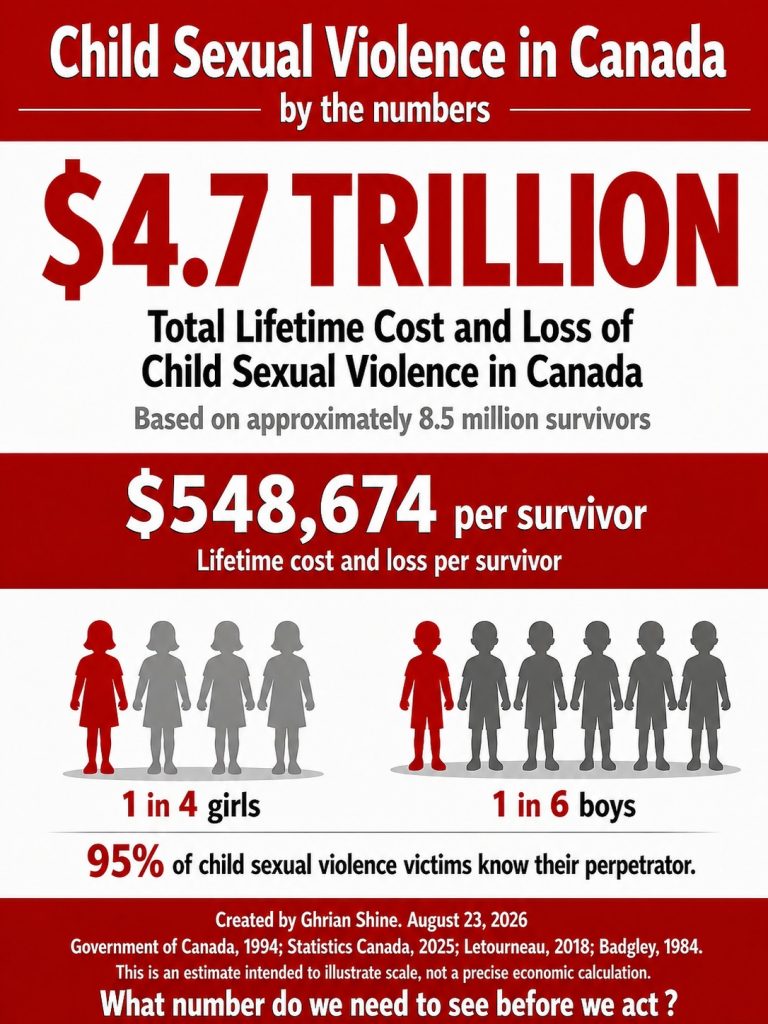
Canada is losing approximately $4.7 trillion in lifetime economic cost and loss because we have never fully counted the impact of child sexual violence.
That estimate is based on approximately 8.5 million people in Canada affected by child sexual violence and an estimated lifetime economic cost and loss of $548,674 CAD per survivor.
Despite decades of surveys, population statistics and national reporting, Canada has never produced a comprehensive estimate of the lifetime economic cost and loss of child sexual violence.
This is not an oversight.
It is a systemic failure that costs lives, futures and trillions of dollars.
We are very keen on counting the money.
Well, let us count it.
$4.7 trillion.
The Government of Canada has estimated that 1 in 4 girls and 1 in 6 boys experience child sexual violence before age 18 (Health Canada, 1994). When those estimates are applied to Canada’s population, that brings us to approximately 8.5 million survivors of child sexual violence (Statistics Canada 2025).
And even that number may not tell the whole story. Child sexual violence is greatly underreported. Many victims never tell anyone.
About 95 percent of child sexual violence is committed by someone the child knows, making the violence deeply personal, hidden and devastating (Badgley et al., 1984).
We go on and on about Canada’s federal debt, currently about $1.32 trillion. The estimated $4.7 trillion lifetime economic cost and loss of child sexual violence is more than three and a half times that amount (Department of Finance Canada, 2026). The Department of Finance reported a federal accumulated deficit of $1.322 trillion as of March 31, 2026.
The Lifetime Cost and Lost Potential of Child Sexual Violence
Peer reviewed research led by Elizabeth Letourneau estimates the lifetime economic burden of nonfatal child sexual violence for a female survivor at $282,734 USD in 2015 dollars (Letourneau et al., 2018).
That number includes cost and loss.
There is a difference.
Cost is what society spends dealing with the consequences.
Health care. Mental health care. Child welfare. Criminal justice. Special education.
Loss is what disappears.
Income. Employment. Productivity. Opportunity. Economic participation. Human potential.
Of Letourneau’s $282,734 lifetime estimate, $223,581 is productivity loss (Letourneau et al., 2018).
That is the largest piece.
Other research shows what that lost productivity can look like in real lives.
Using data from The Irish Longitudinal Study on Ageing, Barrett et al. (2014) found that men who reported experiencing child sexual violence were almost three times more likely to be out of the labour force because of sickness or disability. They also had significantly lower incomes.
The researchers did not find the same statistically significant effects for women.
That does not erase the economic consequences for women.
It shows us, once again, how complicated the data are and how much more research is needed.
Child sexual violence does not just cost us money.
We lose money.
We lose productivity.
We lose human potential.
And Canada has never comprehensively counted it.
But Canada has tried to count part of it before.
In 2003, Canadian researchers Olena Hankivsky and D. A. Draker published a peer reviewed study specifically examining the economic costs of child sexual violence in Canada.
Using 1997 to 1998 data, they estimated the economic cost at more than $3.6 billion annually (Hankivsky & Draker, 2003).
Based on the population affected in their analysis, that works out to approximately $585 per person, per year, or about $1.60 per person, per day.
Think about that.
$1.60 a day.
That number alone reveals how limited the estimate was. It is difficult to imagine that $1.60 a day could capture the full economic cost and loss associated with child sexual violence across a person’s life.
Their analysis included both public and private costs across health, social and public services, justice, and education, research and employment.
Hankivsky and Draker themselves recognized the limitations of what they were able to measure.
They called their analysis preliminary.
More than 20 years later, we are still dealing with the same problem.
We still do not have a comprehensive Canadian lifetime economic calculation specifically for child sexual violence.
In Canada, child maltreatment was already estimated to impose a minimum economic burden of $15.7 billion annually more than two decades ago (Bowlus et al., 2003).
The Public Health Agency of Canada confirms that child maltreatment is widespread, causes lifelong harm and generates major social and economic consequences, yet Canada still lacks a comprehensive lifetime economic analysis specifically focused on child sexual violence (Public Health Agency of Canada, 2016).
This is not an oversight.
It is a systemic failure.
Canada has known about the problem for decades but has never fully measured its economic impact.
This is the gap.
Canada does not produce a comprehensive lifetime economic cost and loss per survivor of child sexual violence.
As a result, applying an established per survivor economic model is not a choice.
It is necessary.
How I Got to $4.7 Trillion
I want to be completely transparent.
I am not an economist.
This is an estimate built from peer reviewed research, Canadian population data, inflation data and currency conversion.
Letourneau et al. (2018) calculated the average lifetime economic cost and loss of nonfatal child sexual violence for a female survivor at $282,734 USD in 2015 dollars. The study specifically includes health care, productivity losses, child welfare, violence and crime, special education and suicide death costs.
That figure was brought forward to 2026 US dollars for inflation and then converted to Canadian dollars.
For consistency throughout this article and the infographic, the working figure is:
$548,674 CAD per survivor.
Apply that to approximately 8.5 million people in Canada and the potential lifetime economic cost and loss is approximately:
$4.7 TRILLION CAD
Because inflation measures and currency exchange rates fluctuate, the exact per survivor figure will vary slightly depending on the measure and date used.
That is why I have locked the estimate at $548,674 per survivor and rounded the national estimate to $4.7 trillion.
The complete maths is shown in the annotated references.
That is not $4.7 trillion sitting on a government invoice somewhere.
It is the potential economic burden carried across millions of lives.
Then I Hit the Data Wall
Letourneau and her colleagues calculated the lifetime economic cost and loss for female survivors of nonfatal child sexual violence.
They tried to calculate it for male survivors too.
They could not produce a comparable complete estimate because adequate research on productivity losses for male survivors was unavailable (Letourneau et al., 2018). Their resulting nonfatal male estimate was $74,691, but the researchers explicitly identified the missing productivity data as the reason it was lower.
That does not mean child sexual violence costs men less.
It means we do not know.
There was not enough evidence.
That is a research gap.
A big one.
So rather than invent a number, this analysis applies Letourneau’s female nonfatal estimate to everyone.
That does not mean I am claiming the economic consequences are identical for women and men.
I am not.
It means the female figure is the strongest complete lifetime estimate available for calculating both cost and loss.
Until better male data exist, I would rather tell you what we do not know than pretend we know it.
Then I Found Another Gap
Letourneau also calculated the lifetime economic cost of fatal child sexual violence.
The average was $1,128,334 USD for a female victim and $1,482,933 USD for a male victim (Letourneau et al., 2018).
Those numbers are substantially higher.
So naturally I asked:
How many fatal cases should we include in the Canadian calculation?
And there was the next problem.
Canada collects information about child maltreatment deaths, but I could not find reliable national data that isolate deaths caused specifically by child sexual violence.
Without that information, I cannot responsibly determine how many fatal cases should be included in the estimated 8.5 million.
So I did not include them separately.
The $4.7 trillion calculation uses Letourneau’s nonfatal female estimate as a proxy across the entire estimated population.
Fatal cases are not calculated separately.
Again, we do not know enough.
Another research gap.
It is starting to feel like Canada specializes in not knowing.
That might be funny if we were not talking about children.
The Human Cost
But what about the children?
The Government of Canada was publishing the statistic that 1 in 4 girls and 1 in 6 boys had been sexually abused by age 18 in 1994 (National Clearinghouse on Family Violence, 1994).
More than 30 years ago.
While we obsess over dollars, lives are being destroyed and futures stolen.
This is not just a number.
This is decades of ignored suffering, economic loss and societal damage.
Look at the references.
Face the truths we are still refusing to face.
The Original War
This is the original war.
The war against children.
Control the children and you control the parents.
Control the parents and you control the community.
Control the communities and you control the country.
Control the countries and you control the world.
History is watching.
This is your moment to act.
One Bold Step Towards a Solution. A Call to Action.
Prime Minister Mark Carney, order a new Royal Commission.
You are the only person who can make this happen.
The national examination that gave us the Badgley Report was more than 40 years ago (Badgley et al., 1984).
Consider the human cost.
Consider the lives destroyed.
Consider the potential $4.7 trillion in lifetime economic cost and loss.
Consider what could be reclaimed for Canada.
This is not a request.
This is your chance to act.
Will you say yes?
Preventing Child Sexual Violence
Prevention starts with education, justice and a whole lot of love.
Foundations of Prevention
Prevention must begin in early childhood. Children need age-appropriate education starting in the early years, including pre school programs, that teach them what safe touch and unsafe touch are. They need to understand their bodies belong to them, how to recognize when something is wrong, what to do if it happens and who they can safely tell.
Above all, children must be taught to trust themselves and believe their own voice.
This is not optional.
It is foundational.
Good intentions start as ideas, but that is not enough.
Ideas don’t protect kids.
Action does.
I am going to share something that has been sitting with me. I know I am not the first person to see the connection between these mandates, or to sit at a kitchen table with a laptop and a pile of books, trying to figure out how to make them mean something real.
How to make them help.
The goal is simple, and it is not small.
Protect children.
Equip families.
Strengthen communities.
But none of that happens if policy stays on paper.
It has to move.
It has to be lived.
Policy and Implementation Gaps
Erin’s Law in Ontario came into force on September 1, 2024. It requires every school board to establish a policy under which students are engaged annually, in a developmentally appropriate way, on child sexual violence prevention and reporting. Boards must also make information available to parents and guardians and provide information annually to teachers and other school staff (Government of Ontario, 2024).
Nearly two years later, implementation is moving forward across Ontario.
But there is a problem.
I could not find a publicly available province wide accounting showing how many of Ontario’s 72 school boards have fully implemented every requirement of Erin’s Law.
Passing a law is the beginning.
Not the finish line.
The Truth and Reconciliation Commission of Canada released its 94 Calls to Action in 2015 as a roadmap to address the lasting harms of residential schools and move this country toward something better (Truth and Reconciliation Commission of Canada, 2015).
Several of these calls focus directly on education and the safety and wellbeing of children.
Calls to Action 62 to 65 address education.
Calls to Action 1 to 5 address child welfare.
Taken together, they make one thing clear.
Education and child protection are inseparable, and preventing harm, including violence against children, demands coordinated, sustained action across both systems.
Shared Responsibility and Systems Change
This also requires a shift in how we think about responsibility.
A siloed, ownership based approach to policy and service delivery keeps systems fragmented and children falling through the cracks.
The Calls to Action point toward something different.
Shared responsibility.
Collective care.
Accountability across systems rather than isolated mandates that sit on paper.
A Direct Call to Professionals and Community
So here is the ask to community.
This is for unionized teachers, civil servants and community service workers.
I am saying unionized for a reason.
You have a layer of protection that allows you to try, to push and even to fail without losing your livelihood.
If you are serious about service, then use that protection well.
Do not wait for direction.
Help your management do their job better.
Take existing policy and turn it into a program.
Map it clearly.
Show how what you are proposing meets the requirements of Erin’s Law and aligns with the TRC’s Calls to Action.
Put it in a table.
Make it simple.
Make it hard to say no to.
Do this thoughtfully.
Do this with people you trust.
Build a small, quiet group of professionals who are committed to doing good work and seeing it through.
Then move it forward.
And to graduate students, pay attention.
This is not abstract.
This is real, applied and needed.
There are theses sitting all over this paper.
Where is the Canadian lifetime economic analysis of child sexual violence?
Where is the male productivity research?
Where is the national child sexual violence fatality data?
How completely is Erin’s Law being implemented?
What works?
What does not?
Make it your master’s thesis.
Make it your PhD.
Pick one.
Dig.
We need you.
Public Awareness and Duty to Act
People need clear, honest education on what child sexual violence looks like and how to respond.
That means knowing how to speak up and step in when something is wrong, whether the person disclosing is a child or an adult.
Adults must understand that staying silent or ignoring warning signs is enabling.
Enabling is a predator with clean hands.
Silence is violence.
In Canada, every adult has a legal duty to report suspected child sexual violence.
This responsibility does not belong only to teachers, doctors, civil servants or parents.
It belongs to all of us.
Knowing the signs and taking action is not optional.
It is absolute.
Prevention Before Harm Occurs
We also need to confront a harder truth if we are serious about prevention.
People at risk of harming children must have a safe, accountable pathway to come forward and get help before a crime is committed.
That means creating systems where individuals can self report, access specialized treatment and be monitored appropriately.
This is not about sympathy.
It is about stopping harm before it happens.
Scotland has taken leadership in this space through prevention initiatives aimed at people concerned about their own sexual thoughts or behaviour toward children (Police Scotland, 2023).
Canada should be learning from that.
And Scotland is not alone.
Germany is showing us what permanent national oversight can look like.
In 2025, Germany put a federal structure into law that includes an independent commissioner on child sexual violence, a survivor council, an independent commission, research responsibilities and formal reporting requirements (Federal Republic of Germany, 2025).
Think about that.
Oversight.
Survivor participation.
Research.
Reporting.
Accountability.
Built into law.
Canada does not have to invent this from scratch.
Scotland is showing us prevention.
Germany is showing us oversight.
Other countries are building systems around this problem.
Canada should be learning from them.
Organizational Accountability and Oversight
Organizations that serve the public, especially those involving children and adult survivors, must be held to enforceable standards, not internal discretion.
Lions Clubs of Canada, for example, along with religious institutions and community organizations, must be mandated to require vulnerable sector checks for every person involved in programming, leadership, committee or community work.
Not just those they deem “at risk.”
Every board member, staff member, volunteer and contracted service provider working in environments where survivors, both adults and children, are present should be screened.
Some organizations have eventually been forced to face what institutional accountability costs.
In 2023, the Boy Scouts of America emerged from bankruptcy following more than 80,000 claims of childhood sexual violence. A compensation trust valued at approximately $2.4 billion was established through the bankruptcy process (Boy Scouts of America, 2023).
Divide $2.4 billion by 80,000 claims.
Approximately $30,000 per survivor.
That is only a simple average.
Actual compensation is not divided equally and individual awards vary.
But put $30,000 beside the estimated $548,674 lifetime cost and loss per survivor we are examining in this article.
Let the number do the heavy lifting.
And yes, that pisses me off too.
The institution did not simply reach into its own pocket and pay the entire bill for the harm that happened under its watch.
The bankruptcy plan involved the national organization, local councils, insurers and other parties (Boy Scouts of America, 2023).
But something important still happened.
The harm became impossible to ignore.
Survivors became creditors.
Billions of dollars were put behind that acknowledgement.
Compensation began reaching survivors.
And the institution was forced to confront, in dollars, what decades of failing to protect children actually costs.
I am not holding the Boy Scouts up as heroes.
They went into bankruptcy to survive.
But they proved something important.
It can be done.
And there is an important Canadian distinction.
The $2.4 billion trust was created through the Boy Scouts of America bankruptcy. It is not a national compensation fund for people harmed through Scouts Canada.
That is precisely why I am looking south of the border.
More than 80,000 claims were brought into one enormous process.
A $2.4 billion survivor compensation trust was created.
An institution was forced to put real money behind decades of institutional failure.
Canada, look at what is possible.
We do not need to copy their failures.
We need to learn from what finally happened when those failures became impossible to ignore.
The lesson is not that the Boy Scouts got it right.
The lesson is that eventually somebody pays.
The question is whether we wait until after thousands of children have been harmed, or spend our money preventing the violence in the first place.
Accountability, however, cannot depend solely on an organization’s willingness to do the right thing.
There must also be external oversight to ensure compliance.
It is not enough to assume local chapters are doing the right thing.
When organizations operate across thousands of chapters, there must be consistent national standards and independent monitoring.
If organizations fail to comply, authorities must have the power to intervene and shut operations down.
Public trust cannot be built on unchecked systems.
Justice System Reform and Survivor Centered Practice
We need a justice system that truly puts survivors first, not just in words, but in practice.
We also need to expand what justice can look like.
Restorative Justice and Indigenous Knowledge
Restorative justice must be an available option in cases of child sexual violence, when and only when it is survivor led, trauma informed and facilitated by highly trained professionals.
This is not about replacing accountability.
It is about deepening it.
Prior to colonization, invasion, over 500 years ago, many Indigenous communities across what is now known as Canada had their own systems of justice.
These systems often included healing circles and community-based approaches that focused on truth telling, accountability, repair and the restoration of balance.
Harm was not ignored, and it was not minimized.
It was addressed in a way that recognized the humanity of everyone involved while centering the needs of those harmed.
There is knowledge here that has been pushed aside for generations.
It is time to make room for it again.
Restorative justice offers a pathway where survivors can be heard, where those who caused harm must fully face the impact of their actions, and where meaningful accountability goes beyond a sentence served.
For some survivors, this can be a critical part of healing.
For others, it may never be the right choice.
That decision must always belong to the survivor.
This approach must never be forced, rushed or used as a way to reduce consequences.
It requires rigorous safeguards, clear eligibility criteria and ongoing oversight.
It must be led by Indigenous trained practitioners and trauma informed experts who understand both the risks and the responsibility of this work.
We need to invest in building these pathways guided by Indigenous leadership and make them accessible across the country.
That means listening to and partnering with experts who have proven track records in this work, such as Dr. Cindy Blackstock and the First Nations Child and Family Caring Society of Canada.
Their leadership and experience in advancing equity for Indigenous children and families can help inform meaningful and lasting change.
You are not alone in this work.
They love all children.
Restorative justice does not replace the need for a strong legal system.
It strengthens it by adding options that better reflect the needs of survivors.
Restorative justice is not theoretical. In 2019, Canadian survivor Marlee Liss made legal history when her sexual violence case became the first in North America to conclude through a restorative justice process within the court system. Rather than proceeding to a criminal trial, Liss fought for a process that required the man who raped her to undergo extensive therapy before they eventually met in an eight-hour restorative justice circle (International Institute for Restorative Practices, 2024).
I am not asking Canada to imagine this. A Canadian survivor already fought for it and did it.
Training, Standards and Professional Accountability
Judges must be required to complete intensive, in-depth training on child sexual violence, not just attend a brief seminar.
Police must be properly trained to respond from the very first point of contact, before any specialized unit arrives.
Those first moments matter.
They can support a victim or cause further harm, whether the report is immediate or made years later.
All community service professionals should be required to complete ongoing, evidence-based training and pass annual competency testing to ensure they are staying current with research and best practices.
We need litigation lawyers who are specifically trained in child sexual violence.
This work is about more than money.
It must include care beyond the courtroom, including meaningful, long-term aftercare once lawsuits are settled.
Long Term Survivor Support
Survivors need access to sustained, trauma informed support.
That includes therapy, safe housing and financial stability.
Recovery does not follow a timeline, especially for those who disclose in adulthood.
Data, Transparency and Accountability
There must be real accountability when systems fail.
Training alone is not enough.
We need oversight, transparency and independent review when survivors are not protected.
And we need a centralized, transparent database that captures accurate statistics at the national, provincial, territorial and municipal levels.
We cannot address what we refuse to count.
Germany is already demonstrating that permanent national oversight, survivor participation, research and regular reporting can be built into a country’s response to child sexual violence (Federal Republic of Germany, 2025).
This is not theoretical.
It can be done.
This is how prevention becomes real.
Community Based Support Models
We need more places like The Gatehouse, located in Toronto, Ontario, Canada, who are focused exclusively on helping people survive the aftermath of child sexual violence.
We need more Gatehouses.
And not just in name.
These spaces must be staffed by trained professionals who also carry personal lived experience, because good intentions are not enough.
Relying on textbook theory alone can, and does, cause harm.
That standard should extend to everyone involved, including volunteers and placement students.
Clients are not case studies.
They are not lab rats for academic learning, and they are not projects for well meaning community members looking for something to save.
That said, there are excellent professionals who do not have personal lived experience. The difference is that many have spent years working alongside survivors and have learned how to listen. Lived experience matters, but so does the humility to learn from those who carry it.
The Case for Prevention
Prevention is not a soft option.
It is a moral and economic imperative.
Every dollar spent preventing violence has the potential to save lives, futures and enormous economic loss.
If we are willing to educate our children, hold our systems accountable, support survivors for the long term and intervene before harm is done, then we can change this.
If we are not, then we are choosing not to.
And children will keep paying the price.
A Final Call to Action
Here’s my challenge:
If you’re thinking about graduate school, especially if you are part of an underserved or targeted community and have personal lived experience with child sexual violence, study this.
Make it your master’s thesis.
Make it your PhD.
Pick this up and run with it.
I have provided you with a vision and an idea to build from.
Some ideas may not be useful.
Some may simply get you thinking about what is possible.
Dig until the data cannot be ignored.
Build the evidence that forces Canada and the world to face the full truth.
Until we name it, count it and confront it, the violence keeps winning.
 Copyright © August 23, 2026 Ghrian Shine
I receive no financial compensation for this work, nor am I conducting it as part of an academic program. I do this work because I am dedicated to ending child sexual violence through education, justice and a whole lot of love.
Please share this work freely. Please share it often, in the true spirit of knowledge sharing.
Annotated References
Badgley, R. F., et al. (1984).
Sexual offences against children: Report of the Committee on Sexual Offences Against Children and Youths. Government of Canada.
Government of Canada: Badgley Report
The Badgley Report remains one of Canada’s foundational national examinations of sexual violence against children.
It is used in this editorial for the historical finding that the overwhelming majority of children subjected to sexual violence know the person who harms them.
Badgley is not being used as the source for the 1 in 4 girls and 1 in 6 boys calculation.
That prevalence source is the National Clearinghouse on Family Violence publication below.
Bank of Canada. (2026).
Daily exchange rates.
Bank of Canada daily exchange rates
Provides the USD to CAD exchange data used to convert the inflation adjusted Letourneau figure into Canadian dollars.
Exchange rates move daily. For that reason, slightly different calculation dates produce slightly different per survivor figures.
For consistency throughout this editorial and the completed infographic, the working figure is locked at:
$548,674 CAD per survivor.
The small variation produced by the precise inflation measure and exchange date does not materially change the rounded national estimate of $4.7 trillion.
Barrett, A., Kamiya, Y., & O’Sullivan, V. (2014).
Childhood sexual abuse and later-life economic consequences. Journal of Behavioral and Experimental Economics, 53, 10–16.
DOI: 10.1016/j.socec.2014.07.001
Full Barrett, Kamiya & O’Sullivan study
This peer reviewed study examined the relationship between child sexual violence and economic outcomes later in life using data from The Irish Longitudinal Study on Ageing.
The researchers found that men who reported experiencing child sexual violence were almost three times more likely to be out of the labour force because of sickness or disability. They also had significantly lower incomes.
These effects remained after accounting for childhood economic circumstances, other adverse childhood experiences, current mental health difficulties and negative health behaviours.
The researchers did not find statistically significant economic effects for female survivors in this study.
Barrett et al. is included as supporting evidence that child sexual violence can have measurable consequences for employment, income and economic participation later in life.
It is not used to calculate the $548,674 lifetime cost and loss per survivor or the $4.7 trillion national estimate.
Those calculations remain based on Letourneau et al. (2018).
Bowlus, A. J., McKenna, K., Day, T., & Wright, D. (2003).
The economic costs and consequences of child abuse in Canada. Law Commission of Canada.
The Economic Costs and Consequences of Child Abuse in Canada
This Canadian economic study estimated the annual economic burden of child maltreatment at approximately $15.7 billion in 1998 dollars.
It is included to demonstrate that Canada has known for more than two decades that childhood maltreatment carries an enormous economic burden.
Bowlus is Canadian context.
It is not the source of the $548,674 per survivor estimate.
That comes from Letourneau et al. (2018).
Boy Scouts of America. (2023).
Boy Scouts of America emerges from Chapter 11 bankruptcy.
The Boy Scouts of America emerged from Chapter 11 bankruptcy in 2023. Its reorganization established a survivor compensation trust valued at approximately $2.4 billion, following more than 80,000 childhood sexual violence claims.
To give that number some human scale:
$2,400,000,000 ÷ 80,000 claims
= approximately $30,000 per claim.
That is a simple average only.
Actual survivor awards are not equal and depend on the trust’s claims process.
The example is included not to portray the Boy Scouts of America as heroes, but to demonstrate that large scale institutional compensation is possible.
The $2.4 billion trust was created through the US Boy Scouts bankruptcy. It is not an equivalent national compensation fund for people harmed through Scouts Canada.
Department of Finance Canada. (2026).
The Fiscal Monitor: March 2026. Government of Canada.
The Fiscal Monitor: March 2026
The Department of Finance reports federal debt, also called the accumulated deficit, of $1,322,004,000,000 as of March 31, 2026.
Rounded:
$1.32 trillion CAD.
The comparison used in this editorial is:
$4.7 trillion ÷ $1.322 trillion
= approximately 3.56.
In plain language:
The estimated $4.7 trillion lifetime economic cost and loss of child sexual violence is more than three and a half times Canada’s federal debt.
This comparison is intended to give readers a familiar benchmark for comprehending the scale of $4.7 trillion.
Federal Republic of Germany. (2025).
Gesetz zur Einrichtung der oder des Unabhängigen Bundesbeauftragten gegen sexuellen Missbrauch von Kindern und Jugendlichen (Antimissbrauchsbeauftragtengesetz, UBSKMG).
German federal child sexual violence oversight law
Germany enacted legislation in 2025 establishing permanent federal structures addressing sexual violence against children and young people.
The law establishes an independent federal commissioner, a survivor council and an independent commission. It also establishes research and reporting responsibilities.
Germany is included because it demonstrates that national oversight, survivor participation, research and formal accountability can be built into law.
Government of Ontario. (2024).
Erin’s Law (Child Sexual Abuse Prevention and Reporting), 2024, S.O. 2024, c. 33.
Erin’s Law requires every Ontario school board to establish a policy under which students are engaged annually and developmentally appropriately on child sexual violence prevention and reporting.
Boards must also make information available to parents and guardians and provide information annually to teachers and other school staff.
The statute came into force September 1, 2024.
I could not identify a publicly available province wide accounting showing how many of Ontario’s 72 school boards have fully implemented every requirement.
That missing implementation picture is itself worth studying.
Hankivsky, O., & Draker, D. A. (2003).
The economic costs of child sexual abuse in Canada: A preliminary analysis. Journal of Health & Social Policy, 17(2), 1–33.
DOI: 10.1300/J045v17n02_01
This peer reviewed Canadian study specifically examined the economic costs attributable to child sexual violence in Canada.
Using data from the 1997 to 1998 fiscal year, Hankivsky and Draker estimated that the economic cost exceeded $3.6 billion annually.
Their estimate included both public and private costs across four areas: health, social and public services, justice, and education, research and employment.
This study is particularly important to this editorial because it demonstrates that Canadian researchers were already attempting to quantify the economic burden specifically associated with child sexual violence more than 20 years ago.
Hankivsky and Draker provide Canadian historical and economic context.
Their $3.6 billion annual estimate is not used to calculate the $548,674 lifetime cost and loss per survivor or the $4.7 trillion national estimate in this editorial.
Those calculations are based on Letourneau et al. (2018).
The distinction matters.
Hankivsky and Draker estimated an annual Canadian economic burden using 1997 to 1998 data.
This editorial is estimating lifetime economic cost and loss across an estimated population of people in Canada affected by child sexual violence.
The studies therefore support different parts of the argument and their figures should not be added together.
Health Canada, National Clearinghouse on Family Violence. (1994).
When teenage girls have been sexually abused: A guide for teenagers. Health Canada.
Government of Canada publication
This is the prevalence source used in the infographic and national estimate.
The Government of Canada publication reports:
1 in 4 girls.
1 in 6 boys.
Sexually abused by age 18.
Importantly, these figures are before age 18, not the narrower under age 15 definition found in some Canadian surveys.
Now apply those prevalence estimates to the 2025 Canadian population:
Women = 20,841,344.
20,841,344 ÷ 4
= 5,210,336 estimated female survivors.
Men = 20,810,309.
20,810,309 ÷ 6
= 3,468,385 estimated male survivors.
Combined:
5,210,336 + 3,468,385
= 8,678,721.
For clarity and consistency throughout the editorial and infographic, this is conservatively rounded to:
Approximately 8.5 million people.
This calculation applies historical prevalence estimates to a current population. It is an estimate of scale, not a literal count of living Canadian survivors.
International Institute for Restorative Practices. (2024, January 18). Voice to power in restorative justice with Marlee Liss. Restorative Works! Podcast.
Voice to Power in Restorative Justice with Marlee Liss
Marlee Liss discusses her experience as a survivor of sexual violence whose case became the first in North America to conclude through restorative justice processes within the courts. She describes how the traditional criminal justice process left her feeling powerless and how the restorative process centred her needs and voice. Liss emphasizes that restorative justice in cases of sexual violence must involve skilled, trauma informed practitioners and must centre the survivor.
Letourneau, E. J., Brown, D. S., Fang, X., Hassan, A., & Mercy, J. A. (2018).
The economic burden of child sexual abuse in the United States. Child Abuse & Neglect, 79, 413–422.
DOI: 10.1016/j.chiabu.2018.02.020
This is the primary economic source underlying the $4.7 trillion editorial estimate.
Letourneau and colleagues estimated the average lifetime economic burden of nonfatal child sexual violence for a female victim at:
$282,734 USD in 2015 dollars.
The components include health care, productivity losses, child welfare, violence and crime, special education and suicide death costs.
Productivity loss alone was:
$223,581 USD.
The researchers could not produce a comparable complete male estimate because adequate estimates of male productivity losses were unavailable. Their reported nonfatal male estimate was consequently $74,691.
Rather than pretend the incomplete male figure represents the actual economic burden for male survivors, this editorial applies the more complete female nonfatal estimate as a proxy across the estimated survivor population.
That is a limitation.
It is also a research gap.
Letourneau separately estimated the lifetime economic cost of fatal child sexual violence at:
Female victim = $1,128,334 USD.
Male victim = $1,482,933 USD.
Fatal cases are not separately incorporated into my Canadian estimate because I could not identify reliable national Canadian data showing how many deaths are attributable specifically to child sexual violence.
Another gap.
Public Health Agency of Canada. (2016).
The Chief Public Health Officer’s report on the state of public health in Canada 2016: A focus on family violence in Canada. Government of Canada.
A Focus on Family Violence in Canada
Provides Canadian context concerning the prevalence, consequences and economic burden associated with family violence and child maltreatment.
It is included because Canada has extensive evidence that childhood maltreatment causes lifelong human and economic harm while still lacking the comprehensive lifetime child sexual violence specific economic analysis this editorial is calling for.
Police Scotland. (2023, September 25).
#GetHelpOrGetCaught: How we’re tackling child sexual abuse [Video]. YouTube.
This is the Scottish video used in the original article.
It is included as an international example of prevention that attempts to reach people at risk of sexually harming children before another child is harmed.
The point is simple.
Prevention does not have to begin after the crime.
Statistics Canada. (2025, September 24).
Canada’s population estimates: Age and gender, July 1, 2025. Government of Canada.
Canada’s population estimates: Age and gender, July 1, 2025
Provides the 2025 Canadian population basis used to scale the prevalence estimate.
The detailed population figures used in this editorial are:
Women = 20,841,344.
Men = 20,810,309.
Those population figures are combined with the Government of Canada 1994 prevalence estimates to produce the approximately 8.5 million figure.
Statistics Canada supplies the population.
It does not supply the 1 in 4 and 1 in 6 prevalence figures used here.
That distinction is deliberate.
Statistics Canada. (n.d.).
Population estimates on July 1, by age and gender (Table 17-10-0005-01). Government of Canada.
Statistics Canada Table 17-10-0005-01
This is the detailed Statistics Canada population table underlying the 2025 female and male population figures used above.
It provides estimated population counts by age and gender and is the population dataset supporting the survivor calculation.
The Gatehouse. (n.d.).
The Gatehouse.
The Gatehouse in Toronto provides specialized community based support for survivors of child sexual violence.
It is included as an example of the type of survivor centred, trauma informed community resource this editorial argues should exist more widely.
Truth and Reconciliation Commission of Canada. (2015).
Calls to Action.
Truth and Reconciliation Commission of Canada: Calls to Action
The 94 Calls to Action provide a national framework for addressing the continuing consequences of residential schools and colonial systems.
Calls to Action 1 to 5 address child welfare.
Calls to Action 62 to 65 address education and reconciliation.
Together they reinforce the need for coordinated approaches to education, child wellbeing, Indigenous knowledge and systemic accountability.
U.S. Bureau of Labor Statistics. (2026).
Consumer Price Index.
U.S. Bureau of Labor Statistics Consumer Price Index
The Consumer Price Index is used to bring Letourneau’s $282,734 USD estimate in 2015 dollars forward to 2026 purchasing power.
For transparency, the calculation proceeds like this:
$282,734 USD in 2015 dollars.
Adjusted for inflation = approximately $398,000 USD in 2026 dollars.
Converted to Canadian dollars = approximately $548,000 CAD per survivor.
Because the exact result changes slightly according to the inflation measure and exchange date selected, this editorial uses the locked working figure:
$548,674 CAD per survivor.
Now apply that figure to the rounded survivor estimate:
8,500,000 × $548,674
= $4,663,729,000,000.
Rounded:
$4.7 trillion CAD.
This is an estimate intended to illustrate scale, not a precise economic calculation.
The Economic Argument
Yes, I used ChatGPT to help with the math.
The research is cited.
The sources are linked.
The calculations are shown.
Judges are using AI to write rulings now.
If that makes you uncomfortable, good.
You should be paying attention.
Copyright © August 23, 2026 Ghrian Shine
I receive no financial compensation for this work, nor am I conducting it as part of an academic program. I do this work because I am dedicated to ending child sexual violence through education, justice and a whole lot of love.
Please share this work freely. Please share it often, in the true spirit of knowledge sharing.