
**This is independent, non-commercial research undertaken in the public interest. It was written to be shared freely and often, in the true spirit of knowledge sharing.**
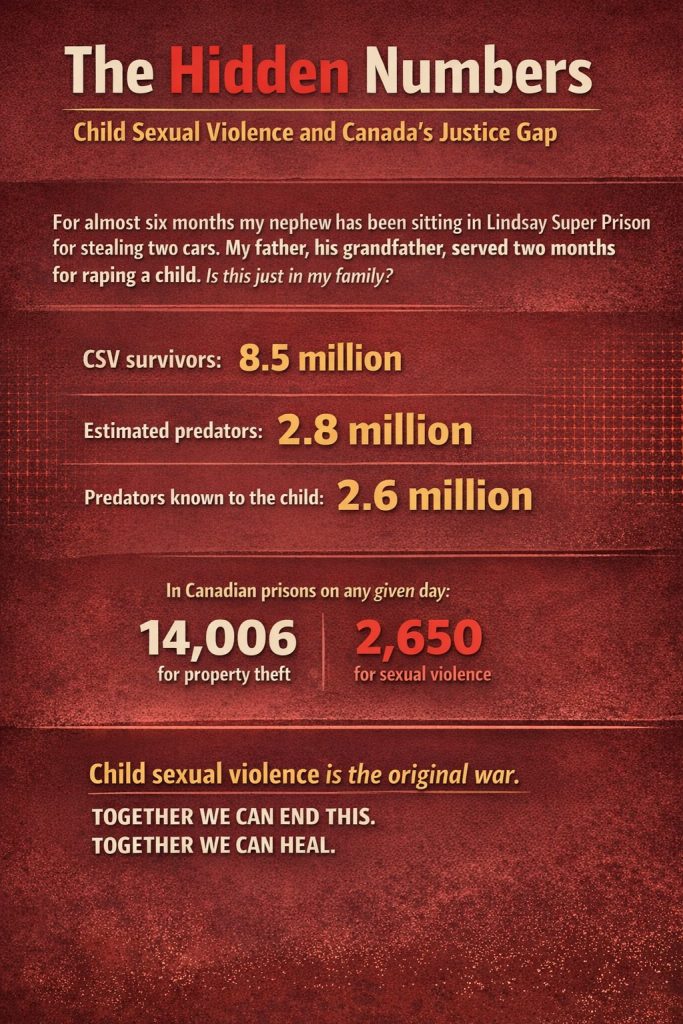
My nephew has been sitting in Central East Correctional Centre in Lindsay for almost six months for stealing two cars. Triple time. Meanwhile, his grandfather, my dad, served two months for raping a child. That’s the system in action. That’s what Canada values. Property gets protection, kids barely get a second thought. That hit me like a gut punch. Cars get more justice than children.
It got me thinking is this just my family, or is the system broken across the board? I started looking and the numbers hit even harder.
The Scope of the Problem
The Government of Canada has estimated that 1 in 4 girls and 1 in 6 boys experience child sexual violence before age 18 (Health Canada, 1994). When those estimates are applied to Canada’s population, that brings us to approximately 8.5 million survivors of child sexual violence (Statistics Canada 2025).
And even that number may not tell the whole story. Child sexual violence is greatly underreported. Many victims never tell anyone.
About 95 percent of child sexual violence is committed by someone the child knows, making the violence deeply personal, hidden and devastating (Badgley et al., 1984).
Estimating the Number of Predators
So how many predators are out there, really? I ran the numbers. If each predator has, on average, three victims, that means there are roughly 2.8 million predators in Canada. And of those, almost 2.6 million are people the child actually knows. That’s staggering.
To estimate, I assumed each predator has three victims. Research shows that many child sexual offenders abuse multiple victims, though numbers vary depending on offender profile and circumstances. Some have only one known victim, others have many more. For analysis, I applied a working assumption of three victims per predator (Whitaker et al., 2008; Baglivio & Wolff, 2021; Keelan & Fremouw, 2013).
Calculating the Numbers
CSV survivors: 8,500,000 (8.5 million) (Statistics Canada 2020; Badgley, 1984)
Average victims per predator: 3
Predators known to the child: 95 percent (Badgley, 1984)
Total predators = 8,500,000 ÷ 3 ≈ 2,833,333 (conservatively rounded to 2.8 million)
Predators known to the child = 0.95 × 2,833,333 ≈ 2,691,666 (conservatively rounded way down to 2.6 million)
Prison Population Comparison
According to Statistics Canada, the total adult incarcerated population in Canada was approximately 37,854 on an average day in 2018/2019. About 37% were serving sentences for property offences such as break and enter and theft, while approximately 7% were incarcerated for sexual assault-related offences, which include all forms of sexual violence (Statistics Canada, 1998; Malakieh, 2020).
Property offences: 37% of 37,854 ≈ 14,006 prisoners currently sitting in jail for stealing property
Sexual assault-related offences: 7% of 37,854 ≈ 2,650 prisoners currently behind bars for rape
On any given day in Canada, far more people are incarcerated for property theft than for child sexual violence, despite the enormous prevalence of child sexual violence in the community. Comparing this to the estimated millions of child sexual predators underscores the gap between estimated offender prevalence and how the justice system currently incarcerates offenders.
The math doesn’t lie. The system treats stolen cars as a bigger threat than child sexual violence.
Now I see why my nephew is doing triple time for swiping a couple of cars while his grandfather got two months for raping a child. This is what Canada actually values. Cash, property, stuff you can put a number on. Kids? Their safety barely registers. The system protects what it can count, not what matters. That realization should make you furious.
This isn’t just a statistic. It’s a declaration of what Canada prioritizes. Kids get failed, families get shattered, and predators walk free while property gets locked up tight. We can see it, we can name it, and we can decide we’re not going to accept it anymore.
Declaration of Resolve
Child sexual violence is the original war, the war against children. Control the children, you control the parents. Control the parents, you control the community. Control the communities, you control the country. Control the countries, you control the world. Together we can end this. Together we can heal.
 Copyright © June 15, 2026 Ghrian Shine
I receive no financial compensation for this work, nor am I conducting it as part of an academic program. I do this work because I am dedicated to ending child sexual violence through education, justice and a whole lot of love.
Please share this work freely. Please share it often, in the true spirit of knowledge sharing.
Annotated Bibliography
Badgley, P. (1984). Child sexual abuse: The Canadian Badgley Royal Commission, Report on Sexual Offences Against Children and Youths. https://www.anbu.ca/statistics-and-research/?utm_source=chatgpt.com
Baglivio, M. T., & Wolff, K. T. (2021). Adverse childhood experiences distinguish violent juvenile sexual offenders’ victim typologies. International Journal of Environmental Research and Public Health, 18(21), 11345. https://doi.org/10.3390/ijerph182111345
Health Canada, National Clearinghouse on Family Violence. (1994).
When teenage girls have been sexually abused: A guide for teenagers. Health Canada.
Government of Canada publication
This is the prevalence source used in the infographic and national estimate.
The Government of Canada publication reports:
1 in 4 girls.
1 in 6 boys.
Sexually abused by age 18.
Importantly, these figures are before age 18, not the narrower under age 15 definition found in some Canadian surveys.
Now apply those prevalence estimates to the 2025 Canadian population:
Women = 20,841,344.
20,841,344 ÷ 4
= 5,210,336 estimated female survivors.
Men = 20,810,309.
20,810,309 ÷ 6
= 3,468,385 estimated male survivors.
Combined:
5,210,336 + 3,468,385
= 8,678,721.
For clarity and consistency throughout the editorial, this is conservatively rounded to:
Approximately 8.5 million people.
This calculation applies historical prevalence estimates to a current population. It is an estimate of scale, not a literal count of living Canadian survivors.
Keelan, C. M., & Fremouw, W. J. (2013). Child versus peer/adult offenders: A critical review of juvenile sex offender literature. Aggression and Violent Behavior, 18(6), 732–744. https://doi.org/10.1016/j.avb.2013.08.003
Malakieh, J. (2020). Adult and youth correctional statistics in Canada, 2018/2019 (Catalogue no. 85 601 XIE). Statistics Canada. https://www150.statcan.gc.ca/n1/pub/85-002-x/2020001/article/00016-eng.htm
Statistics Canada. (1998). Corrections key indicator report: Distribution of most serious offences among incarcerated adults (Catalogue no. 85 002 XIE, Vol. 18, No. 8). https://www150.statcan.gc.ca/n1/pub/85-222-x/85-222-x1998000-eng.pdf
Statistics Canada. (2020). Childhood maltreatment in Canada. https://www150.statcan.gc.ca/n1/pub/85-002-x/2020001/article/00001-eng.htm
Statistics Canada. (n.d.).
Population estimates on July 1, by age and gender (Table 17-10-0005-01). Government of Canada.
Statistics Canada Table 17-10-0005-01
This is the detailed Statistics Canada population table underlying the 2025 female and male population figures used above.
It provides estimated population counts by age and gender and is the population dataset supporting the survivor calculation.
Whitaker, D. J., Le, B., Hanson, R. K., Baker, C. K., McMahon, P. M., Ryan, G., & Klein, A. (2008). Risk factors for the perpetration of child sexual abuse: A review and meta-analysis. Child Abuse & Neglect, 32(5), 529–548. https://doi.org/10.1016/j.chiabu.2007.08.005
Copyright © June 15, 2026 Ghrian Shine
I receive no financial compensation for this work, nor am I conducting it as part of an academic program. I do this work because I am dedicated to ending child sexual violence through education, justice and a whole lot of love.
Please share this work freely. Please share it often, in the true spirit of knowledge sharing.