
💲💲💲 Money
Money Report 2026
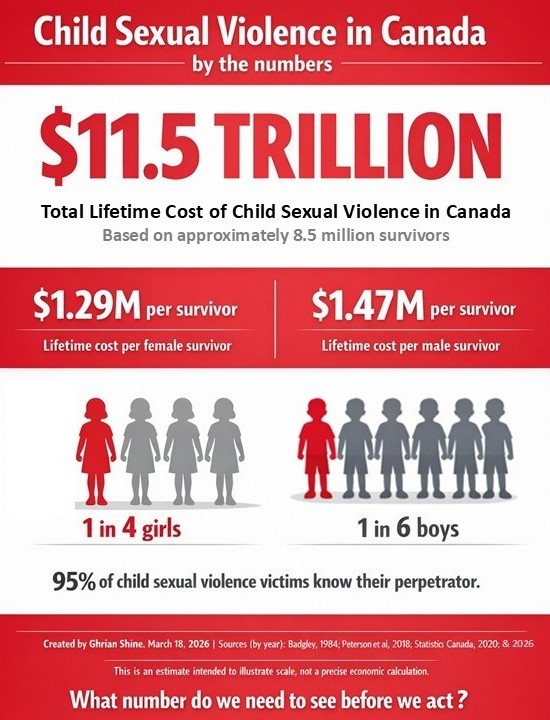
Canada is losing $11.5 trillion because we have never fully counted the lifetime economic cost of child sexual violence. That is 8.5 million survivors, each carrying a cost of $1.47 million, adjusted to Canadian dollars. Women bear the majority of the burden, and the economy still undervalues their work. Despite decades of data, including surveys, population statistics, and national reporting, Canada has never produced a comprehensive estimate of lifetime costs. This is not an oversight. It is a systemic failure that costs lives, futures, and trillions of dollars.
We are very keen on counting the money.
Well, let us count $11.5 trillion, based on approximately 8.5 million survivors in Canada. This estimate applies Badgley’s historical prevalence rates of 1 in 4 girls and 1 in 6 boys to the most recent population data (Badgley, 1984; Statistics Canada, n.d.). Nearly all child sexual violence—about 95 percent—is committed by someone the child knows and trusts, making the harm deeply personal, hidden, and devastating.
The Lifetime Cost and Lost Potential of Child Sexual Violence
Peer-reviewed research in the United States estimates the lifetime economic burden of child sexual violence at approximately $1.47 million per survivor when adjusted to Canadian dollars (Peterson et al., 2018). Canada has never conducted its own comprehensive analysis. This is not an oversight or a minor gap. It is a decades-long failure to confront the full scale of harm. Because Canada has never measured lifetime costs per survivor, applying established per-survivor cost models like Peterson’s is not a choice. It is the only way to begin counting what has been ignored for too long.
In Canada, child maltreatment already imposes a substantial economic burden, estimated at $15.7 billion annually, with the majority of costs driven by long term productivity losses (Fang et al., 2012). The Public Health Agency of Canada confirms that child maltreatment is widespread, causes lifelong harm, and generates major social and economic costs, yet Canada still lacks comprehensive data on the lifetime costs of child sexual violence (Public Health Agency of Canada, 2016). This is not an oversight. It is a systemic failure. Canada has known about the problem for decades, but has never fully measured its economic impact. Because of this gap, we must apply established per-survivor cost models to estimate the national loss, $11.5 trillion and counting.
This is the gap. Canada does not produce a comprehensive lifetime economic cost per survivor of child sexual violence. As a result, applying established per-survivor cost models is not a choice. It is necessary.
But that number reflects average earnings. When we account for the wage gap, where women earn about 88 cents for every dollar men earn, the measured loss per female survivor drops to about $1.29 million (Statistics Canada, 2026).
That does not mean the harm is less. It means the economy values women’s work less.
Women also make up the majority of survivors.
So even though each woman is assigned a lower dollar value, they carry the greater total loss.
This is not just a social failure. It is an economic catastrophe, a miscounting of trillions of dollars while absorbing the damage at scale.
If women’s losses were measured at equal value, the total economic cost would be even higher.
We are not just losing money. We are miscounting it.
The Human Cost
But what about the children? The statistics we are using to measure the impact of child sexual violence are over 40 years old (Badgley, 1984). Four decades. While we obsess over dollars, lives are being destroyed, futures stolen, and women are hit harder than men even for the same work.
This is not just a number. This is decades of ignored suffering, economic loss, and societal damage.
Look at the references. Face the truths we are still refusing to face.
The Original War
This is the original war. The war against children. Control the children and you control the parents. Control the parents and you control the community. Control the communities and you control the country. Control the countries and you control the world.
History is watching. This is your moment to act.
One Bold Step Towards a Solution. A Call to Action.
Prime Minister Mark Carney, order a new Royal Commission. You are the only person who can make this happen.
Consider the human cost. Consider the lives destroyed. Consider the $11.5 trillion lost and what could be reclaimed for Canada.
This is not a request. This is your chance to act. Will you say yes?
Preventing Child Sexual Violence
Prevention starts with education, justice, and a whole lot of love.
Foundations of Prevention
Prevention must begin in early childhood. Children need age-appropriate education starting in the early years, including pre-school programs, that teach them what safe touch and unsafe touch are. They need to understand their bodies belong to them, how to recognize when something is wrong, what to do if it happens, and who they can safely tell. Above all, children must be taught to trust themselves and believe their own voice. This is not optional. It is foundational.
Good intentions start as ideas, but that is not enough. Ideas don’t protect kids. Action does.
I am going to share something that has been sitting with me. I know I am not the first person to see the connection between these mandates, or to sit at a kitchen table with a laptop and a pile of books, trying to figure out how to make them mean something real. How to make them help.
The goal is simple, and it is not small. Protect children. Equip families. Strengthen communities.
But none of that happens if policy stays on paper. It has to move. It has to be lived.
Policy and Implementation Gaps
Erin’s Law in Ontario, passed in 2024, requires publicly funded school boards to deliver age appropriate education that teaches students how to recognize, prevent, and report child sexual violence, while ensuring educators are trained and parents or guardians are informed about the curriculum. The goal is to give children clear language and practical tools to identify unsafe situations and seek help. Yet 18 months later, implementation remains limited. Out of 72 school boards, only about four have begun putting it into practice. More than 1,200 private schools are not required to follow it, and there is no federal Ministry of Education to enforce a consistent national standard (Ontario Ministry of Education, 2024).
The Truth and Reconciliation Commission (TRC) of Canada released its 94 Calls to Action in 2015 as a roadmap to address the lasting harms of residential schools and move this country toward something better. Several of these calls focus directly on education and the safety and wellbeing of children. Calls to Action 62 to 65 require age appropriate learning on Indigenous history, residential schools, and ongoing impacts, along with proper training for educators and the integration of Indigenous knowledge in classrooms. Calls to Action 1 to 5 focus on child welfare, including reducing the overrepresentation of Indigenous children in care, ensuring culturally appropriate placements, and addressing the conditions that put children at risk in the first place. Taken together, they make one thing clear. Education and child protection are inseparable, and preventing harm, including violence against children, demands coordinated, sustained action across both systems (Truth and Reconciliation Commission of Canada, 2015).
Shared Responsibility and Systems Change
This also requires a shift in how we think about responsibility. A siloed, ownership based approach to policy and service delivery keeps systems fragmented and children falling through the cracks. The Calls to Action point toward something different, shared responsibility, collective care, and accountability across systems rather than isolated mandates that sit on paper.
A Direct Call to Professionals and Community
So here is the ask to community.
This is for unionized teachers, civil servants, and community service workers. I am saying unionized for a reason. You have a layer of protection that allows you to try, to push, and even to fail without losing your livelihood. If you are serious about service, then use that protection well.
Do not wait for direction. Help your management do their job better. Take existing policy and turn it into a program. Map it clearly. Show how what you are proposing meets the requirements of Erin’s Law and aligns with the TRC’s Calls to Action. Put it in a table. Make it simple. Make it hard to say no to.
Do this thoughtfully. Do this with people you trust. Build a small, quiet group of professionals who are committed to doing good work and seeing it through. Then move it forward.
And to graduate students, pay attention. This is not abstract. This is real, applied, and needed. There is a strong thesis sitting right here if you are willing to take it on.
Public Awareness and Duty to Act
People need clear, honest education on what child sexual violence looks like and how to respond. That means knowing how to speak up and step in when something is wrong, whether the person disclosing is a child or an adult. Adults must understand that staying silent or ignoring warning signs is enabling. Enabling is a predator with clean hands. Silence is violence.
In Canada, every adult has a legal duty to report suspected child sexual violence. This responsibility does not belong only to teachers, doctors, civil servants, or parents. It belongs to all of us. Knowing the signs and taking action is not optional. It is absolute.
Prevention Before Harm Occurs
We also need to confront a harder truth if we are serious about prevention. People at risk of harming children must have a safe, accountable pathway to come forward and get help before a crime is committed. That means creating systems where individuals can self-report, access specialized treatment, and be monitored appropriately. This is not about sympathy. It is about stopping harm before it happens. Countries like Scotland have taken leadership in this space, building prevention models that focus on early intervention and risk reduction. Canada should be learning from that.
Organizational Accountability and Oversight
Organizations that serve the public, especially those involving children, must be held to enforceable standards, not internal discretion. Groups like Lions Clubs of Canada, along with religious institutions and community organizations, must be mandated to require vulnerable sector checks for every person involved in programming, leadership, committee or community work. Not just those they deem “at risk.” Every board member, staff member, volunteer, and contracted service provider working in environments where survivors, both adults and children, are present should be screened.
Some organizations have demonstrated that accountability, while painful and costly, is possible. In 2023, the Boy Scouts of America emerged from bankruptcy after publicly acknowledging that it had failed to protect thousands of children from sexual violence over many decades. While no settlement can undo the profound harm caused, the organization established a multi-billion-dollar compensation trust for survivors, issued a public apology, and implemented stronger child protection measures. Their response is examined in the 2023 Netflix documentary Scouts Honor: The Secret Files of the Boy Scouts of America. This is one example of what institutional accountability can look like: acknowledging the harm, accepting responsibility, compensating survivors, and taking meaningful steps to help prevent it from happening again.
Accountability, however, cannot depend solely on an organization’s willingness to do the right thing. There must also be external oversight to ensure compliance. It is not enough to assume local chapters are doing the right thing. When organizations operate across thousands of chapters, as is the case across Canada, there must be consistent national standards and independent monitoring. If organizations fail to comply, authorities must have the power to intervene and shut operations down. Public trust cannot be built on unchecked systems.
Justice System Reform and Survivor-Centered Practice
We need a justice system that truly puts survivors first, not just in words, but in practice.
We also need to expand what justice can look like.
Restorative Justice and Indigenous Knowledge
Restorative justice must be an available option in cases of child sexual violence, when and only when it is survivor-led, trauma-informed, and facilitated by highly trained professionals. This is not about replacing accountability. It is about deepening it.
Prior to colonization (invasion) over 500 years ago, many Indigenous communities across what is now known as Canada had their own systems of justice. These systems often included healing circles and community-based approaches that focused on truth-telling, accountability, repair, and the restoration of balance. Harm was not ignored, and it was not minimized. It was addressed in a way that recognized the humanity of everyone involved while centering the needs of those harmed.
There is knowledge here that has been pushed aside for generations. It is time to make room for it again.
Restorative justice offers a pathway where survivors can be heard, where those who caused harm must fully face the impact of their actions, and where meaningful accountability goes beyond a sentence served. For some survivors, this can be a critical part of healing. For others, it may never be the right choice. That decision must always belong to the survivor.
This approach must never be forced, rushed, or used as a way to reduce consequences. It requires rigorous safeguards, clear eligibility criteria, and ongoing oversight. It must be led by Indigenous-trained practitioners and trauma-informed experts who understand both the risks and the responsibility of this work.
We need to invest in building these pathways guided by Indigenous leadership and make them accessible across the country. That means listening to and partnering with experts who have proven track records in this work, such as Dr. Cindy Blackstock and the First Nations Child and Family Caring Society of Canada. Their leadership and experience in advancing equity for Indigenous children and families can help inform meaningful and lasting change. You are not alone in this work. They love all children.
Restorative justice does not replace the need for a strong legal system. It strengthens it by adding options that better reflect the needs of survivors.
Training, Standards, and Professional Accountability
Judges must be required to complete intensive, in-depth training on child sexual violence, not just attend a brief seminar.
Police must be properly trained to respond from the very first point of contact, before any specialized unit arrives. Those first moments matter. They can support a victim or cause further harm, whether the report is immediate or made years later.
All community service professionals should be required to complete ongoing, evidence-based training and pass annual competency testing to ensure they are staying current with research and best practices.
We need litigation lawyers who are specifically trained in child sexual violence. This work is about more than money. It must include care beyond the courtroom, including meaningful, long-term aftercare once lawsuits are settled.
Long-Term Survivor Support
Survivors need access to sustained, trauma-informed support. That includes therapy, safe housing, and financial stability. Recovery does not follow a timeline, especially for those who disclose in adulthood.
Data, Transparency, and Accountability
There must be real accountability when systems fail. Training alone is not enough. We need oversight, transparency, and independent review when survivors are not protected.
And we need a centralized, transparent database that captures accurate statistics at the national, provincial, territory, and municipal levels. We cannot address what we refuse to count.
This is how prevention becomes real.
Community-Based Support Models
We need more places like The Gatehouse, located in Toronto, Ontario, Canada, who are focused exclusively on helping people survive the aftermath of child sexual violence. We need more Gatehouses.
And not just in name. These spaces must be staffed by trained professionals who also carry lived experience, because good intentions are not enough. Relying on textbook theory alone can, and does, cause harm. That standard should extend to everyone involved, including volunteers and placement students.
Clients are not case studies. They are not lab rats for academic learning, and they are not projects for well meaning community members looking for something to save.
The Case for Prevention
Prevention is not a soft option. It is a moral and economic imperative. Every dollar spent preventing violence saves lives, futures, and trillions in lost economic productivity.
If we are willing to educate our children, hold our systems accountable, support survivors for the long term, and intervene before harm is done, then we can change this.
If we are not, then we are choosing not to.
And children will keep paying the price.
A Final Call to Action
Here’s my challenge: If you’re thinking about graduate school, especially if you are part of an underserved or targeted community and have personal lived experience with child sexual violence, study this. Make it your thesis. Make it your PhD. Pick this up and run with it.
I have provided you with a vision and an idea to build from. Some ideas may not be useful, some may simply get you thinking about what is possible. Dig until the data cannot be ignored. Build the evidence that forces Canada and the world to face the full truth.
Until we name it, count it, and confront it, the violence keeps winning.
The Economic Argument
Yes, I used ChatGPT for the math. Judges are using AI to write rulings now. If that makes you uncomfortable, good. You should be paying attention.
This is an estimate intended to illustrate scale, not a precise economic calculation.
 Copyright © March 18, 2026 Ghrian Shine
Annotated Reference List
Badgley, P. (1984). Child sexual abuse: The Canadian Badgley Royal Commission, Report on Sexual Offences Against Children and Youths. https://www.anbu.ca/statistics-and-research/?utm_source=chatgpt.com
Provides foundational national survey data on child sexual violence in Canada. Reports that 1 in 3 girls and 1 in 6 boys experience an unwanted sexual act, commonly rounded to 1 in 4 girls in contemporary reporting. Notes that 95% of child sexual violence victims know their perpetrator, emphasizing that violence is overwhelmingly committed by someone the child trusts. Offers data on differential risk, showing that women, girls, Indigenous people, people with disabilities, and 2SLGBTQ+ individuals face significantly higher risks (pp. 175, 215–218). Establishes a historical baseline for prevalence, informs policy, and guides research.
Fang, X., Brown, D. S., Florence, C., & Mercy, J. A. (2012). The economic burden of child maltreatment in the United States and implications for prevention. Child Abuse & Neglect, 36(2), 156–165.(PDF) The Economic Burden of Child Maltreatment in the United States And Implications for Prevention
Offers an authoritative economic analysis of child maltreatment, showing annual U.S. costs in the tens of billions and providing methodological guidance for calculating societal and productivity losses. Canadian studies have applied similar methods to estimate the national economic burden at $15.7 billion annually, demonstrating that the problem is measurable and significant. The study highlights that Canada is failing to produce its own lifetime cost estimates, which is a critical gap in policy and prevention planning.
Ontario Ministry of Education. (2024). Erin’s Law. Government of Ontario. https://www.ontario.ca
Outlines the legislative requirements and intent of Erin’s Law, including mandatory prevention education for students, educator training, and parent engagement. Provides a credible primary source establishing the policy framework, though implementation progress across school boards is limited.
Peterson, C., Kearns, M. C., McIntosh, W., Estefan, L. F., Nicolaidis, C., & Florence, C. S. (2018). Lifetime economic burden of child sexual abuse in the United States. Child Abuse & Neglect, 79, 413–422. https://doi.org/10.1016/j.chiabu.2018.02.016
Provides a peer-reviewed estimate of the lifetime cost of child sexual violence in the United States, calculated at approximately $830,928 USD per survivor in 2015. Adjusted to current Canadian dollars, this translates to roughly $1.47 million per survivor today. The study captures long-term societal costs, including productivity loss, healthcare, and intergenerational impacts. Its methodology provides the foundation for applying per-survivor cost models to Canadian data, which is necessary because Canada has not produced comparable lifetime economic estimates. Using this model for Canada:
Men: 3,468,385 × $1.47M ≈ $5.09 trillion lost income
Women: 5,210,336 × $1.29M ≈ $6.72 trillion lost income (adjusted for 88¢ wage gap)
Total estimated lifetime income loss ≈ $11.81 trillion, conservatively rounded to $11.5 trillion
Public Health Agency of Canada. (2016). The Chief Public Health Officer’s Report on the State of Public Health in Canada: A Focus on Family Violence. Government of Canada. The Chief Public Health Officer’s Report on the State of Public Health in Canada 2016 – A Focus on Family Violence in Canada – Canada.ca
Confirms that child maltreatment is widespread, causes lifelong harm, and generates substantial social and economic costs. The report explicitly notes that Canada does not have comprehensive data on the lifetime costs of child sexual violence, leaving a critical gap in policy and planning. This gap demonstrates a decades-long failure to account for the full economic and societal impact of child sexual violence, making application of per-survivor cost models, such as those in Peterson et al., 2018, not optional but essential for understanding the scale of the problem.
Statistics Canada. (2020). Childhood maltreatment in Canada. https://www150.statcan.gc.ca/n1/pub/85-002-x/2020001/article/00001-eng.htm
Provides national survey data on childhood maltreatment, including self-reported experiences of child sexual violence before age 15. Approximately 1 in 4 women and 1 in 6 men report sexual violence during childhood. These prevalence rates are essential for estimating the total number of survivors in Canada. They reveal the scale of the problem and highlight that despite decades of data collection, Canada still does not produce a comprehensive lifetime economic cost per survivor, a failure that allows the full societal and financial impact to remain invisible. Using 2025 population totals:
Women: 20,841,344 ÷ 4 = 5,210,336 survivors
Men: 20,810,309 ÷ 6 = 3,468,385 survivors
Total survivors ≈ 8,678,721 (~8.5 million)
Statistics Canada. (2025, September 24). Canada’s population estimates: Age and gender, July 1, 2025. Government of Canada. https://www150.statcan.gc.ca/n1/daily-quotidien/250924/dq250924a-eng.htm
Provides the total population of Canada as of July 1, 2025: 41,651,653, roughly evenly split between women and men. These counts allow the application of prevalence rates from childhood maltreatment surveys to estimate survivor numbers, which in turn underpin the $11.5 trillion national economic loss estimate. This demonstrates how existing population data can be leveraged to measure costs that Canada has failed to calculate directly.
Statistics Canada. (n.d.). Population estimates on July 1st, by age and sex (Table 17-10-0005-01). Government of Canada. Retrieved March 18, 2026, from https://www150.statcan.gc.ca/t1/tbl1/en/tv.action?pid=1710000501
Provides detailed population counts by sex and age, which are used to scale prevalence rates to total survivor counts. For 2025:
Women = 20,841,344
Men = 20,810,309
Applying childhood sexual violence prevalence:
Women survivors = 20,841,344 ÷ 4 = 5,210,336
Men survivors = 20,810,309 ÷ 6 = 3,468,385
Total survivors ≈ 8.5 million
This highlights that while Canada has the data to estimate costs, it has not produced a comprehensive lifetime economic analysis, leaving society unaware of the full magnitude of the problem.
Statistics Canada. (2026, March 5). The gender wage gap persists. https://www.statcan.gc.ca/o1/en/plus/9084-gender-wage-gap-persists
Shows that women earned approximately 88 cents for every dollar earned by men in 2025, highlighting systemic economic inequality. When calculating the economic cost of child sexual violence, adjusting female survivor losses for the wage gap demonstrates that the officially measured cost undervalues women’s work, masking the true economic impact and perpetuating gender-based economic injustice.
Truth and Reconciliation Commission of Canada. (2015). Calls to Action. National Centre for Truth and Reconciliation. https://nctr.ca
Outlines 94 Calls to Action addressing the legacy of residential schools and advancing reconciliation. Key sections for this paper include Calls to Action 1–5 on child welfare and 62–65 on education. Emphasizes systemic reform, culturally appropriate care for Indigenous children, and mandatory education on Indigenous history and residential schools. Provides a foundational understanding of the intersection of education, child protection, and violence prevention.
Copyright © March 18, 2026 Ghrian Shine