
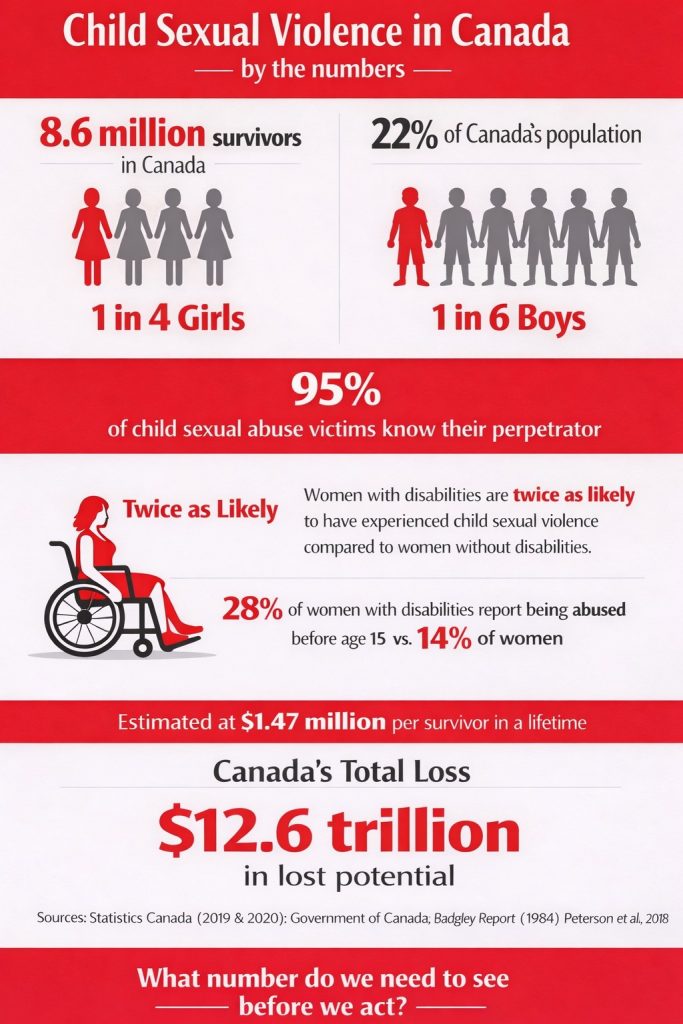
Yesterday, I shared statistics focused on girls.
Why? Because when it comes to economic impact, women are still undervalued.
Today, we include the boys.
To be clear, I have not yet factored in the wage gap between men and women for the same work. That comes next.
These numbers are staggering.
But what’s worse is where they come from.
Please look at the reference list. There are disturbing truths we are still avoiding.
Notice what’s missing. Notice who is missing. Look at the dates.
Canada has not conducted a comprehensive national study in over 40 years.
Much of the data still traces back to 1984.
Why?
Blog Entry: March 18, 2026. I learned more about the money game. Check out my post titled $11.5 Trillion. Living to learn. Learning to love.
Annotated Reference List for Child Sexual Violence
1. Badgley, P. (1984). Child Sexual Abuse: The Canadian Badgley Royal Commission, Report on Sexual Offences Against Children and Youths, pg. 175.
https://www.anbu.ca/statistics-and-research/?utm_source=chatgpt.com
- Provides the foundational national survey on child sexual abuse in Canada. Reports that 1 in 3 girls and 1 in 6 boys experience an unwanted sexual act. Commonly rounded to 1 in 4 girls in contemporary reporting. Establishes historical baseline for prevalence and informs policy and research. *Why did it get rounded up from 1 in 3 to 1 in 4?
2. Statistics Canada. (2020). Childhood maltreatment in Canada.
https://www150.statcan.gc.ca/n1/pub/85-002-x/2020001/article/00001-eng.htm
- National survey reporting that approximately 1 in 4 women and 1 in 6 men report experiencing child sexual violence before age 15. Confirms ongoing prevalence and provides updated figures, representing roughly 8.6 million Canadians living with trauma from childhood sexual abuse. *In Canada you are not an adult until 18-years-old, why did they stopped at 15?
3. Statistics Canada. (2019). Experiences of violent victimization and unwanted sexual behaviours among people with disabilities in Canada, 2018 (Juristat Catalogue No. 85-002-X).
https://www150.statcan.gc.ca/n1/pub/85-002-x/2019001/article/00010-eng.htm
- Demonstrates the increased vulnerability of women with disabilities. Reports 14% of women with disabilities experienced child sexual violence before age 15, nearly double the rate of women without disabilities. Highlights the ongoing disparity into adulthood (39% vs. 24%). Useful for understanding intersectionality and targeted prevention. *Again, we’re stopping at 15 years old, why?
4. Badgley, P. (1984). Child Sexual Abuse: The Canadian Badgley Royal Commission, Report on Sexual Offences Against Children and Youths, pg. 175.
- Notes that 95% of child sexual abuse victims know their perpetrator, emphasizing that abuse is overwhelmingly committed by someone the child trusts. Essential for risk assessment and public awareness campaigns.
5. Badgley, P. (1984). Child Sexual Abuse: The Canadian Badgley Royal Commission, Report on Sexual Offences Against Children and Youths, pp. 215-218.
- Provides data on differential risk, showing that women, girls, Indigenous people, people with disabilities, and 2SLGBTQ+ individuals face significantly higher risks of child sexual violence. Forms the basis for intersectional policy and support services. *Where’s the data for Indigenous, Black, LGBTQ+, and Trans children. Here they just get a footnote. At least they confirm it’s higher, but by how much exactly?
6. Cotter, A. (2022). Sexual misconduct in the Canadian Armed Forces 2022. Statistics Canada.
https://www150.statcan.gc.ca/n1/pub/85-002-x/2022001/article/00001-eng.htm
- Recent research on sexual misconduct, highlighting ongoing systemic issues and confirming that marginalized groups experience disproportionate risk. Offers contemporary context for historical statistics. *This study examines a specific cohort. That is progress. But it also raises an unavoidable question. Where are the studies examining other cohorts? Children attending church on Sundays. Students in educational institutions. Children in government care. Child sexual violence does not belong to one system. Our research should not either.
7. Simpson, L. (2018). Violence against girls and women with disabilities in Canada. Canadian Women’s Foundation.
https://canadianwomen.org/research/violence-against-women-with-disabilities/
- Provides evidence-based discussion of heightened risk for girls and women with disabilities. Confirms the doubled likelihood of abuse relative to non-disabled peers and supports intersectional advocacy and prevention efforts.
8. Peterson, C. etal (2018). The economic burden of child maltreatment in the United States, 2015
Child Abuse & Neglect, Volume 86, December 2018, pp. 178–183 — this journal focuses on research around child abuse and related social/health impacts. According to a 2015 report, the lifetime cost of child sexual violence per survivor is $830,928 USD. When adjusted for inflation and converted to Canadian dollars, that figure is roughly $1.47 million per survivor today. *Canada hasn’t bothered to do this, so we have to ask the Americans for help here. Why is that?
https://www.sciencedirect.com/science/article/abs/pii/S0145213418303867?utm_source=chatgpt.com